Pediatric Urology › Undescended testis
Undescended Testis in Boys: Best Age for Surgery and Orchidopexy
Medically reviewed by Dr. Koushik Herle, MCh, DNB (Paediatric Surgery), Consultant Paediatric Surgeon and Paediatric Urologist, on 29 October 2026
At your baby’s check-up, the doctor feels the scrotum and says one testicle is not there. A relative says, “Wait till he is five, it will come down.” Should you wait?
No. An undescended testis is a testicle that has not come down into the scrotum and has stopped somewhere along its normal path. Doctors also call it cryptorchidism. If the testis has not come down by 6 months of age, it is very unlikely to come down by itself. Surgery to bring it down, called orchidopexy, is best done before the first birthday.
Key points for parents
- A testis that has not come down by 6 months will rarely come down on its own. Waiting until 5 years is a common and harmful myth.
- Surgery is best done between 9 months and 1 year of age.
- The main aims are to protect hormone production and to reduce, and allow early detection of, cancer risk. Fertility is also helped, but it is not the only goal.
- A testis that can be felt is brought down by a small open operation in the groin. Keyhole surgery is for a testis inside the tummy.
- A testis high inside the tummy may need two operations, 6 to 12 months apart.
- Ultrasound and MRI do not decide whether surgery is needed.
- After surgery, boys and later men should check their testes regularly.
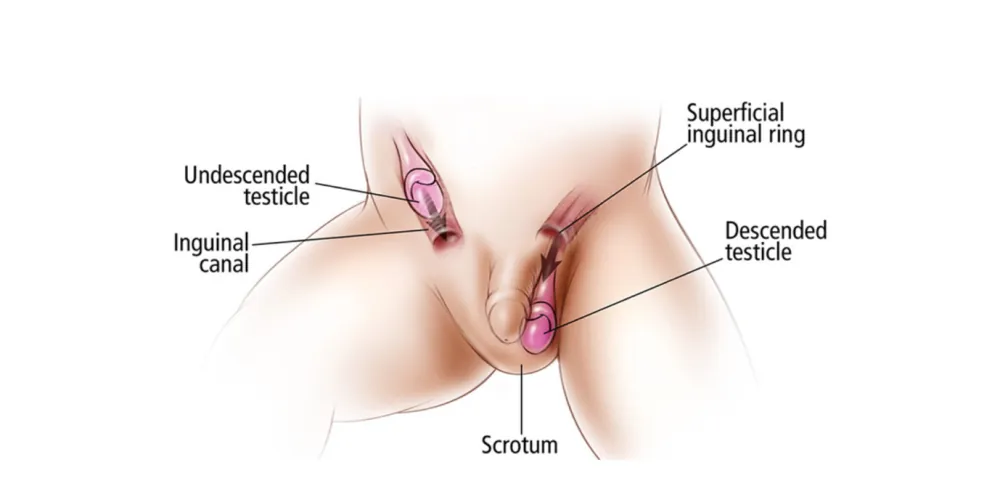
How a testis normally comes down
Early in pregnancy, a baby has no gender. The gonads, which later become ovaries or testes, form high up near the kidneys. As the baby’s genes and hormones switch on, in a boy (XY) they become testes, and then the outer genitals form.
The testes then travel down. They pass through the layers of the tummy wall through an opening called the inguinal canal, come out just under the skin of the groin, and finally settle in the scrotum. This journey is usually complete before birth. In some babies it is slow, and it can finish in the first 6 months after birth.
Types of undescended testis
- Palpable testis: it can be felt in the groin. It has already come through the tummy wall and has only the last short stretch, from the groin to the scrotum, left to travel. This is the commonest and least severe type.
- Non-palpable testis: it cannot be felt. It may be inside the tummy (intra-abdominal), it may never have formed, or it may have shrunk away (atrophied).
- Retractile testis: a normal testis that is pulled up by a muscle reflex but can be brought down into the scrotum and stays there. It usually needs only regular checks.
Why waiting is a mistake
A common piece of advice is to wait until 5 years in case the testis comes down. It almost never does after 6 months, and waiting causes harm:
- Cancer risk: boys with an undescended testis have a higher risk of testicular cancer later. Studies show the risk is higher the later the operation is done. Bringing the testis down early does not take the risk to zero, but it stops the years of extra risk from adding up.
- Growth and quality: the warmth inside the body slows the testis’s growth and affects sperm production.
- Other problems: a testis left in the groin or tummy is more likely to twist (torsion) or shrink away, and a hernia is often present alongside it.

The best age for undescended testis surgery
Babies born early, and the fragile tissues of the newborn period, are reasons to wait a little, and some testes still come down in the first 6 months. So a boy is checked at around 6 months. If the testis is still not down, surgery is planned between 9 months and 1 year. Guidelines advise surgery between 6 and 18 months, and earlier is better. Older boys who were missed should still be seen, because surgery is still recommended.
Why bring it down if the testis is not perfect?
An undescended testis may not be completely normal. Often the testis and the epididymis, the cap on the testis that connects to the sperm tube (vas), are partly separated by a thin layer of tissue. Doctors call this testicular-epididymal disjunction. It is more common and more marked when the testis is high inside the tummy, and less common when it can be felt in the groin. Testes from inside the tummy also tend to be smaller and grow more slowly.
Even so, these testes are working tissue. They make hormones, and they make a variable amount of sperm. A testis should never be dismissed as useless and removed for that reason. Bringing it down matters for three reasons:
- Hormones: the testis makes male hormones needed for normal puberty, even if its sperm cannot travel well.
- Early detection of cancer: once in the scrotum, any change in size or hardness can be felt early, when a cancer is at an early stage and is often treated by removing the testis alone, without chemotherapy. Inside the tummy, a growth can go unnoticed until it is large, and regular scans every year are not practical.
- Fertility: it gives the testis its best chance. Fertility is important, but it is not the main reason for surgery.
If one testis is normal, it is usually enough to father a child. If both testes are undescended, a fuller hormone and genetic assessment is needed, and some men may later need help with fertility.
Tests your child may need
The diagnosis is made by examination. Ultrasound and MRI are not needed to diagnose an undescended testis and do not help plan the operation. They are not always accurate: even if a scan says the testis is absent, surgery is still needed to look for it and check any remaining tissue. Scans do have a role when the genitals look unusual or the child’s sex is unclear. When both testes cannot be felt, blood tests for hormones are arranged.
How the decision is made
The deciding question is whether the testis can be felt. A palpable testis is brought down by a short open operation in the groin. A non-palpable testis needs a keyhole look inside the tummy first. Hormone injections, such as hCG, have been tried to bring testes down, but they rarely work, so surgery remains the treatment.
How orchidopexy is done
The operation is done under general anaesthesia, usually with a local anaesthetic block for comfort afterwards.
- Open orchidopexy (palpable testis): a small cut in the groin frees the testis and its cord, and the testis is fixed in a pocket in the scrotum. Any hernia sac is closed at the same time.
- Laparoscopic orchidopexy (non-palpable testis): a small camera is passed into the tummy to find the testis and bring it down as far as is safe.
- Two-stage surgery: a testis high inside the tummy may not have enough length of blood vessels and sperm tube to reach the scrotum in one go. It is brought down as far as is safe, and as those structures stretch and lengthen, the rest of the journey is completed in a second operation 6 months to 1 year later.
Why open surgery for a testis that can be felt? Some parents expect keyhole surgery and are disappointed to hear the operation will be open. Keyhole surgery means placing a camera inside the tummy. A palpable testis has already come through the tummy wall on its own and lies under the skin, so the camera has nothing to see. Open surgery is the right operation here. It is good news: this is the least severe type, with the best chance of a normal-sized, well-functioning testis.
Why two operations for some boys? It is not because the surgery went wrong. The testis’s blood vessels and sperm tube are simply too short to stretch all the way at once. Pulling harder could snap the blood supply and lose the testis. A planned second stage keeps it safe.
Hospital stay
Open orchidopexy is usually a day-care operation, and most boys go home the same day. After laparoscopic surgery, some children stay overnight.
Recovery at home
| When | What to expect |
|---|
| Days 1 to 3 | Some swelling and bruising of the scrotum and groin. Regular pain relief as advised. Loose clothing. |
| Week 1 | Back to normal feeds and play indoors. Gentle baths when advised. |
| Weeks 2 to 3 | Avoid straddle toys, bicycles and rough play. |
| After 6 weeks | Follow-up check of the testis position and size. |
Call the surgical team the same day if: your child has a fever, the wound becomes red, swollen or leaks pus, or the scrotum becomes very swollen or painful.
Possible complications
Complications are uncommon. They include wound infection, bleeding, the testis moving back up, and, rarely, the testis shrinking because its blood supply is affected, which is more likely with a testis from high inside the tummy. Your surgeon will discuss these before the operation.
Follow-up and outlook
The testis is checked a few weeks after surgery and again over the following years. A testis brought down from the groin usually grows well. One brought down from inside the tummy may stay smaller. Bringing it down does not remove every risk, because the testis may have been different from the start. From the teenage years, regular self-examination is important: any new swelling, change in size or hardness should be checked promptly.
Why a paediatric surgeon or paediatric urologist
Undescended testis surgery is done on babies, with small, delicate blood vessels and sperm tubes. A paediatric surgeon or urologist is trained in this operation, in children’s anaesthesia, and in deciding when one or two stages are safest.
Frequently asked questions
Will the testis come down by itself if we wait?
If it has not come down by 6 months of age, it is very unlikely. Waiting until 5 years is a myth, and the delay can harm the testis.
Once it is brought down, is everything normal?
Not always. Surgery protects hormone production and stops extra risk adding up, but the testis may have been different from birth. Regular checks and self-examination later in life are still needed.
Why can’t my son have keyhole surgery?
If the testis can be felt in the groin, it is already outside the tummy, where a keyhole camera cannot reach. Open surgery in the groin is the right operation, and this type has the best outlook.
Will he be able to father children?
Most boys with one undescended testis can father children, especially when surgery is done early. When both testes are affected, fertility may be lower, and a fuller assessment is needed.
Does he need an ultrasound before surgery?
Usually not. Scans do not change the decision or the operation, and a scan saying the testis is absent does not avoid surgery.
Questions you may want to ask at your visit
- Can the testis be felt, and where is it?
- Is it a retractile testis, or truly undescended?
- When should the operation be done?
- Will it be open or keyhole surgery, and could it need two stages?
- Is there also a hernia?
- How should we check the testis as he grows?
Consult your paediatric surgeon early to understand your options. Undescended testis surgery before the first birthday gives the testis its best start.
Related pages
References
- European Association of Urology. EAU Guidelines on Paediatric Urology: undescended testes.
- American Urological Association. Evaluation and Treatment of Cryptorchidism.
Clinic locations
- Manipal Hospital, Sarjapur–Marathahalli Road, Bengaluru.
- Manipal Hospital, Electronic City, Bengaluru.
Appointments: +91 8217553785
This page is educational information and is not a substitute for individual medical advice. Drafted with AI assistance and medically reviewed by Dr. Koushik Herle.
