Liver, Pancreas and Spleen Surgery › Biliary atresia
Biliary Atresia in Babies: Prolonged Jaundice, Pale Stools, the Kasai Procedure and Long-Term Care
Medically reviewed by Dr. Koushik Herle, MCh, DNB (Paediatric Surgery), Consultant Pediatric Surgeon and Pediatric Urologist, on 9 November 2026
Almost every second newborn develops mild jaundice, a yellow tint to the skin and the whites of the eyes, in the first few days. In most babies this is “physiological” or “breast milk” jaundice. Doctors keep the baby well fed, sometimes give a day or two of blue-light phototherapy, and the colour fades within about 10 to 14 days.
But what if your baby is now 2, 3 or 4 weeks old and is still yellow? Many babies with the surgical cause look active, feed well and smile. Two things in the diaper matter most:
- The stools look pale: cream, chalky white or light clay-grey instead of mustard yellow or green.
- The urine is dark yellow or tea-coloured and stains the diaper. Normal newborn urine is almost colourless.
Jaundice that lasts beyond 14 days in a term baby (21 days in a preterm baby), with pale stools and dark urine, is not normal newborn jaundice. Bile is not reaching the gut, and the surgical cause that must be ruled out quickly is biliary atresia. In biliary atresia, every week counts. Early assessment by a pediatric surgeon or pediatric liver specialist, ideally before the baby is about 45 to 60 days old, gives the best chance of keeping the baby’s own liver working.
Key points for parents
- Jaundice beyond 2 weeks (3 weeks if preterm) needs a blood test for direct (conjugated) bilirubin, not more days in sunlight.
- Pale or white stools plus dark urine in a jaundiced baby is an urgent warning sign.
- Biliary atresia is a blockage of the bile ducts. No medicine, syrup or herbal drop can open a scarred duct.
- The treatment is the Kasai operation, ideally in the first 2 months of life. The earlier it is done, the better the chance of bile flow.
- Some babies later need a liver transplant, even after a good Kasai. Lifelong follow-up with a liver specialist is needed.
- After surgery, fever or pale stools returning can mean a bile duct infection (cholangitis). Go to the hospital the same day.
Do not wait if your baby is over 2 weeks old and still yellow. Ask for a fractionated (total and direct) bilirubin blood test and check the stool colour. Go to the nearest hospital the same day if there is bleeding (from the cord, from a heel prick or in the stool), black or blood-stained vomit, extreme sleepiness, or a high fever.
What is biliary atresia?
The liver makes bile, a greenish-yellow fluid. Bile helps the gut absorb fats and the fat-soluble vitamins A, D, E and K, and it carries a yellow pigment (bilirubin) out of the body in the stool. Bile normally leaves the liver through a branching network of tiny pipes, the bile ducts, and part of it is stored in the gallbladder before it enters the small intestine.
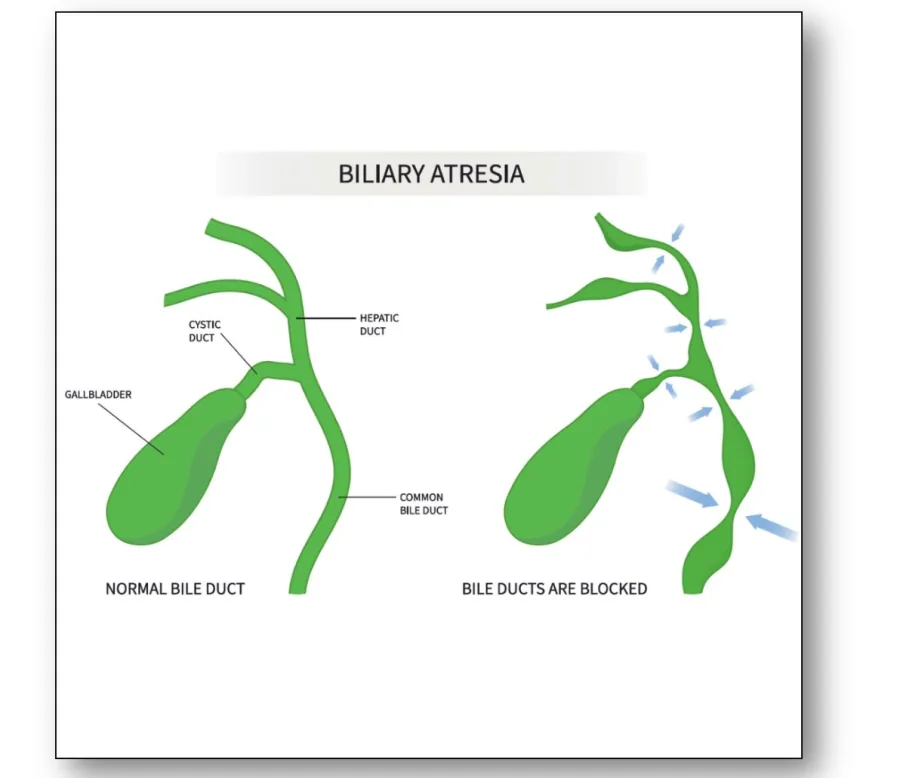
Biliary refers to the bile ducts and atresia means a passage that is closed or missing. In biliary atresia, inflammation damages the bile ducts around the time of birth or soon after. The ducts outside the liver, and later those inside it, turn into scarred, solid cords. As a result:
- Little or no bile reaches the intestine. The stool turns pale, and the baby cannot absorb fat and fat-soluble vitamins properly.
- Bile backs up into the blood. The skin and eyes turn yellow and the urine turns dark.
- The liver is scarred. Trapped bile damages liver cells. Over weeks and months this leads to fibrosis and then cirrhosis, and eventually liver failure if the blockage is not bypassed in time.
Normal newborn jaundice or biliary atresia?
Many babies with biliary atresia are found late because they look chubby and healthy in the first month and the yellow colour is put down to breast milk jaundice. The differences are:
| Normal or breast milk jaundice | Biliary atresia (surgical jaundice) |
|---|
| Bilirubin in blood | Mostly unconjugated (indirect) | Conjugated (direct) bilirubin raised. A direct bilirubin above about 1 mg/dL, or more than 20% of the total, is always abnormal and needs urgent assessment. |
| Urine | Pale, like water | Dark yellow or tea-coloured, stains the diaper |
| Stool | Mustard yellow, golden or green | Pale yellow, cream, grey or chalky white |
| Time course | Usually settles by 10 to 14 days | Persists and often deepens after 2 weeks |
Types of biliary atresia
Doctors describe biliary atresia in two ways: by what else is affected, and by where the blockage lies.
Clinical forms
- Isolated (perinatal) biliary atresia: the large majority of babies. They have no other birth defects, and the ducts probably open at first before closing in the first weeks of life.
- Embryonal form, including BASM (biliary atresia splenic malformation): a smaller group in whom the ducts did not form properly very early in pregnancy. Jaundice starts from birth. BASM may come with several small spleens or no spleen, a central liver, an unusual vein behind the liver or a heart murmur.
- Cystic biliary atresia: a small group with a cyst near the blocked duct. It can sometimes be seen on a pregnancy scan and must be told apart from a choledochal cyst, which behaves differently.
Anatomical types (Japanese classification)
- Type I: only the lowest part of the main bile duct is blocked.
- Type II: the blockage is in the middle duct (common hepatic duct).
- Type III: the large majority of cases. The whole duct system outside the liver, up to the base of the liver (porta hepatis), is blocked. This is the type most often treated with the Kasai operation.
What causes it?
The first question parents ask is, “Why did this happen to my baby?” Biliary atresia affects roughly 1 in 10,000 to 1 in 15,000 live births in Western countries and is reported to be somewhat more common in parts of Asia. It is not caused by anything the mother ate, any medicine, or anything parents did or did not do in pregnancy. It is not an inherited disease in the usual sense, and the chance of a second affected child in the family is very low.
The cause is not fully understood. Research points to a combination of factors around birth:
- a viral or environmental trigger affecting the lining of the baby’s bile ducts;
- an over-active immune response in a susceptible baby, which keeps damaging the ducts after the trigger has gone;
- in some babies, a developmental change early in pregnancy in how the ducts form.
Signs parents notice
Early signs (about weeks 2 to 6)
- Yellow eyes and skin lasting past 14 days.
- Pale, clay-coloured or white stools. Judge the colour in daylight, ideally against a stool colour card, and look at the inside of the stool. A pale stool sitting in a diaper stained with dark urine can look yellow on the outside.
- Dark yellow or tea-coloured urine that stains the diaper.
- A baby who otherwise looks well and feeds actively.
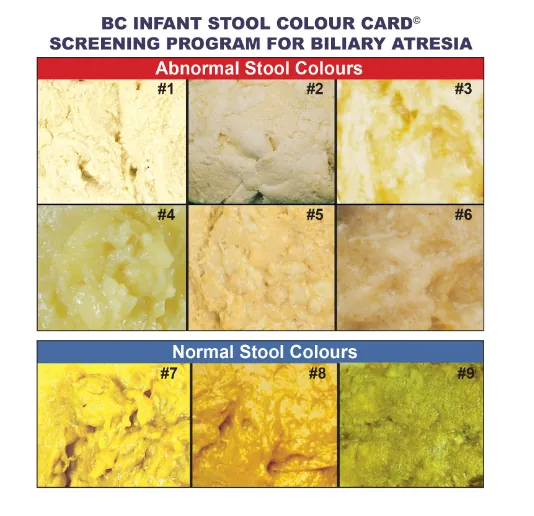
Infant stool colour card. Compare your baby’s stool, in daylight, with the colours on the card. Pale shades (white, grey, cream) need the same-day opinion described above.
Later signs, if diagnosis is delayed
- A firm, swollen tummy from an enlarged liver and spleen.
- Poor weight gain despite feeding, because fat cannot be absorbed without bile.
- Easy bruising or bleeding, including from the cord stump or a heel-prick site, because vitamin K is not absorbed. Bleeding inside the head can occur and is an emergency.
- Fluid in the tummy, and prominent veins on the tummy, from advanced liver scarring.
- Irritability and itching.
How biliary atresia is diagnosed
Jaundice in a newborn that needs surgery (surgical jaundice) is separated from medical causes by a short set of tests. A baby with conjugated jaundice can have other conditions: neonatal hepatitis, congenital infections, metabolic liver disease, Alagille syndrome, alpha-1 antitrypsin deficiency, or thickened bile plugs. Because time matters, the work-up is planned to be quick, often over a few days, and is done together with a pediatric liver specialist (hepatologist), radiologist and anaesthetist.
- Blood tests: total and direct bilirubin, liver enzymes including GGT (often high in biliary atresia), clotting tests and albumin. Vitamin K is usually given before any procedure. Newer markers such as serum MMP-7 may be used where available.
- Fasting ultrasound of the abdomen: the baby is fasted for a few hours (with a drip if needed). An experienced pediatric radiologist looks for an absent, small or poorly contracting gallbladder, a “triangular cord” sign of scar tissue at the liver hilum, and associated findings such as multiple small spleens.
- HIDA scan (hepatobiliary scintigraphy), in selected babies: a harmless tracer is injected and followed. If the tracer reaches the intestine, the ducts are open and biliary atresia is effectively ruled out. If it does not, biliary atresia is suspected, although severe hepatitis can look the same. When the picture is already clear, or the baby is close to 60 days, the team may skip it so that surgery is not delayed.
- Liver biopsy: under sedation and local anaesthesia, a fine needle takes a small sample of liver tissue. The microscope can show features that favour biliary atresia and help tell it from hepatitis.
- Operative cholangiogram: the most definitive test is done in the operating theatre. The surgeon inspects the liver and gallbladder, and if possible injects contrast dye into the gallbladder under X-ray. If dye flows freely into the gut and the liver ducts, the baby does not have biliary atresia, and the operation ends there. If the ducts are blocked, biliary atresia is confirmed and the Kasai operation is done in the same anaesthetic.
Treatment: the Kasai procedure
No drops, syrups or medicines can dissolve the scar in biliary atresia. The standard first operation is the Kasai procedure (hepatoportoenterostomy), named after the Japanese surgeon who developed it. Kasai surgery is best done at a centre with pediatric liver and transplant support.
How it works
Even though the large bile ducts are scarred, there are still microscopic bile channels in the fibrous tissue at the base of the liver. The operation gives those channels a way to drain. It usually takes several hours and has these steps:
- Remove the blocked bile duct remnant and the shrivelled gallbladder, up to the base of the liver, to expose the microscopic bile channels.
- Make a Roux-en-Y loop: a segment of the baby’s small intestine is brought up as a separate drainage limb, and the rest of the intestine is reconnected so that milk flows down normally.
- Join the loop to the liver: the open end of this limb is stitched around the base of the liver.
- Bile can now drain from the liver channels into the intestine.
Open or keyhole surgery?
Keyhole (laparoscopic) surgery is used for many pediatric conditions, but for the Kasai procedure the open approach remains the usual standard in most centres. The fine dissection at the base of the liver needs precision, and results with keyhole Kasai have not been shown to be better than open surgery. See also keyhole surgery in children.
Why the 60-day clock matters
The age at the Kasai operation is the main factor that doctors and parents can influence. Every week that bile stays trapped, more of the microscopic channels are lost. In general, the chance of clearing jaundice is highest when surgery is done in the first 2 months of life and falls steadily as the baby gets older. Published results vary between centres, so ask the treating team about their own results.
The “rule of thirds”
Outcomes after the Kasai procedure are often described in rough thirds:
- About one third: bile flow is good and lasting, jaundice clears, and the child grows up with their own liver, possibly into adulthood.
- About one third: bile flow is good at first and the child grows well for some years, but liver scarring slowly progresses and a transplant is needed later in childhood.
- About one third: bile flow does not establish despite a technically good operation, and a liver transplant is needed in the first one to two years of life.
Even when a transplant is needed later, a Kasai operation that works can give the child time to grow bigger and stronger, which makes a later transplant safer.
Hospital stay after the operation
- Length of stay: commonly about a week to ten days.
- First days: the baby is looked after in the neonatal or pediatric intensive care unit, or a close-observation ward. For the first few days the gut rests while the new join heals. Fluids and nutrition are given through a drip, and a thin tube through the nose keeps the stomach empty.
- Pain relief: given with liver-friendly medicines.
- Drain: a small soft tube near the wound is often left for a few days to watch for fluid or a leak, and is removed before discharge.
- Feeds: start slowly once the bowel is working, with breast milk or a special formula.
- The diaper: stools may turn green or brown within days, or change gradually from pale cream to yellow and mustard over a few weeks as swelling at the liver settles.
Life at home after the Kasai procedure
After discharge, the baby’s care is shared between the pediatric surgeon and the pediatric liver specialist. The usual plan includes:
- Ursodeoxycholic acid (UDCA) to help bile flow.
- Preventive antibiotics for the first months after surgery, to reduce the risk of infection travelling up the intestinal loop into the liver. The duration is set by the team.
- Fat-soluble vitamins A, D, E and K in supplement form, with blood levels checked from time to time.
- Steroids: some centres use a short tapering course after surgery, but studies have not shown a clear benefit, so practice varies. The treating team decides.
- Nutrition: babies with biliary atresia need more calories and absorb fat poorly. Breastfeeding is encouraged and is often topped up with a formula or oil rich in medium-chain triglycerides (MCT), which the gut can absorb without bile. A dietitian guides this.
Medicine safety. Children with liver disease should not be given painkillers such as ibuprofen, mefenamic acid or aspirin unless the liver team says so. Ask the liver doctor which fever and pain medicine to use and at what dose.
Complications to watch for after the Kasai procedure
Ascending cholangitis
This is a bacterial infection of the bile ducts, and it is common in the first years after the Kasai procedure, because the intestinal loop lacks the normal valve that stops bacteria from travelling upward. Each episode can inflame and scar the new channels, so it is treated as an emergency. Warning signs:
- an unexplained fever, even without a cold or cough;
- pale stools returning after they had turned yellow or green;
- deepening jaundice or darker urine;
- sleepiness, irritability or poor feeding.
Go to the hospital the same day. Treatment is usually admission and intravenous antibiotics for about one to two weeks.
Portal hypertension and varices
Even when jaundice clears, the liver may stay stiff. Blood from the gut then pushes harder through the liver, and pressure rises in the portal vein. This can cause an enlarged spleen with a low platelet count, fluid in the tummy (ascites), and swollen veins (varices) in the lower food pipe or stomach. Black tarry stools, vomiting of blood or coffee-ground material are emergencies. Varices are monitored and can be treated with endoscopic procedures. See also the liver, pancreas and spleen surgery page.
When is a liver transplant needed?
Parents are often frightened by the word “transplant”. Paediatric liver transplantation is an established treatment, and survival at experienced centres is high. A transplant is considered when:
- The baby arrives very late, well past the usual age for a Kasai, with advanced liver failure, so that a Kasai would carry high risk and little chance of benefit.
- The Kasai has not worked: jaundice stays high several months after surgery, or later the child has repeated cholangitis, difficult-to-control portal hypertension or poor growth.
In India, most babies receive a living-donor liver transplant, in which a healthy parent or close relative with a suitable blood group donates a segment of the liver. The liver regrows in both donor and child. Transplant is done at specialised liver transplant centres, and the pediatric surgeon and liver specialist plan the referral.
Myths and facts
- Myth: “Morning sunlight and glucose water will clear it.” Fact: sunlight does not help once a baby is past the first week or two, and glucose water does not clear jaundice. A baby past 2 weeks needs a blood test.
- Myth: “Ayurvedic drops, homeopathy or herbs can open the ducts.” Fact: a scarred duct cannot be reopened with drops. Weeks spent on such remedies are weeks lost, and some herbal products can harm a baby’s liver.
- Myth: “The baby is feeding and smiling, so it cannot be serious.” Fact: babies with biliary atresia often look well in the first month.
Frequently asked questions
My baby’s stool looks yellow on the outside but the doctor says it is pale. Why?
Dark urine in the diaper can stain a pale stool yellow, and the surface of the stool can pick up bilirubin. Break open the stool in daylight. If the inside looks like chalk, cream cheese or grey putty, it is a bile-free stool.
My baby is already 70 or 80 days old. Is it too late for the Kasai operation?
Not automatically. The chances are best in the first 2 months, but many babies who are older still benefit if the liver has not yet developed advanced cirrhosis. The team checks liver function, clotting and the ultrasound urgently and advises on the options, including early transplant assessment.
How will we know whether the Kasai operation has worked?
The team looks at the diaper and the blood tests. Stools turning yellow or green and urine turning pale within a few weeks is a good sign. Doctors usually judge the operation successful when the bilirubin falls into the normal range, roughly in the first 3 to 6 months.
The stools were green after surgery but a month later turned pale again. What does this mean?
It may mean cholangitis. Take the baby to the hospital the same day, particularly if there is fever or deeper jaundice. Early treatment can protect bile flow.
Does my baby need a special vaccination plan?
Yes. Children with chronic liver disease are protected against hepatitis A and B, pneumococcal infection and influenza in addition to the routine schedule. If a transplant is being planned, the timing of live vaccines is coordinated with the liver team.
Will my child be able to go to school and play normally?
Children whose jaundice clears after a Kasai operation can usually attend school and take part in normal childhood activities. If the spleen is enlarged because of portal hypertension, doctors usually advise avoiding rough contact sports to protect it, while encouraging swimming, cycling and other normal play.
If we have another baby, will that baby also have biliary atresia?
Recurrence in siblings is rare because biliary atresia is not a classic inherited disease. After any birth, check the stool colour, and if a baby is still yellow at 2 weeks, ask for a direct bilirubin test.
Questions you may want to ask at your visit
- Is the direct bilirubin raised, and what other causes are being checked?
- How soon can the ultrasound, biopsy and operative cholangiogram be done?
- Who will look after my baby’s liver after the Kasai operation?
- What are this centre’s results for the Kasai procedure?
- Which signs mean we should come to the hospital at once?
- If a transplant is needed, where and when would it be done?
Consult your pediatric surgeon early to understand your options. In biliary atresia, early assessment gives the best chance.
Related pages
References
- Fawaz R, Baumann U, Ekong U, et al. Guideline for the evaluation of cholestatic jaundice in infants: joint recommendations of NASPGHAN and ESPGHAN. Journal of Pediatric Gastroenterology and Nutrition 2017;64:154-168. doi:10.1097/MPG.0000000000001334.
- Bezerra JA, Wells RG, Mack CL, et al. Biliary atresia: clinical and research challenges for the twenty-first century. Hepatology 2018;68:1163-1173. doi:10.1002/hep.29905.
- Hartley JL, Davenport M, Kelly DA. Biliary atresia. The Lancet 2009;374:1704-1713. doi:10.1016/S0140-6736(09)60946-6.
Clinic location
- Manipal Hospital, Electronic City, Bengaluru.
Appointments: +91 8217553785
This page is educational information and is not a substitute for individual medical advice. Drafted with AI assistance and medically reviewed by Dr. Koushik Herle.
