General Surgery › Inguinal hernia in children
Inguinal Hernia in Children: Signs, Why Surgery Is Needed and Recovery
Medically reviewed by Dr. Koushik Herle, MCh, DNB (Paediatric Surgery), Consultant Pediatric Surgeon and Pediatric Urologist, on 9 November 2026
Your child has just been told, “This is an inguinal hernia.” The next question is almost always the same: does it really need an operation, and does it need one now?
An inguinal hernia is a small pouch in the groin that lets bowel slip out of the tummy. In children it needs surgery, and the right time is soon after diagnosis. This page explains why, how the operation is done and what recovery looks like.
Key points for parents
- A hernia in a child is not caused by weak muscles and is not your fault. It is a small pouch that was meant to close early in life and stayed open.
- Boys and girls can both have it. It is far more common in boys.
- It does not go away on its own.
- The danger is that bowel gets stuck in the pouch. This is more common in children than in adults.
- Published studies advise repair within about 2 weeks of diagnosis in infants and young children.
- The operation removes the pouch and closes its base. No mesh is used in children.
- Most children are back to normal play in 1 to 2 days. Heavy sport is avoided for 10 days to 2 weeks.
- All stitches dissolve. Nothing needs to be removed.
This is an emergency. Do not wait. Go to the nearest emergency department at once if the lump is hard, tender, red or will not go back in, or if your child vomits, cries without stopping or refuses feeds.
What is an inguinal hernia in a child?
Before birth, a boy’s testis moves down from the tummy into the scrotum. A small pouch of the tummy lining follows it. This pouch is called the processus vaginalis. It should close and dissolve early in life. In a child with a hernia, it stayed open. Bowel can slip into this open pouch and show as a bulge in the groin or scrotum, often when the child cries or strains.
Think of it as a tunnel that was meant to be sealed after the testis passed through, and was not.

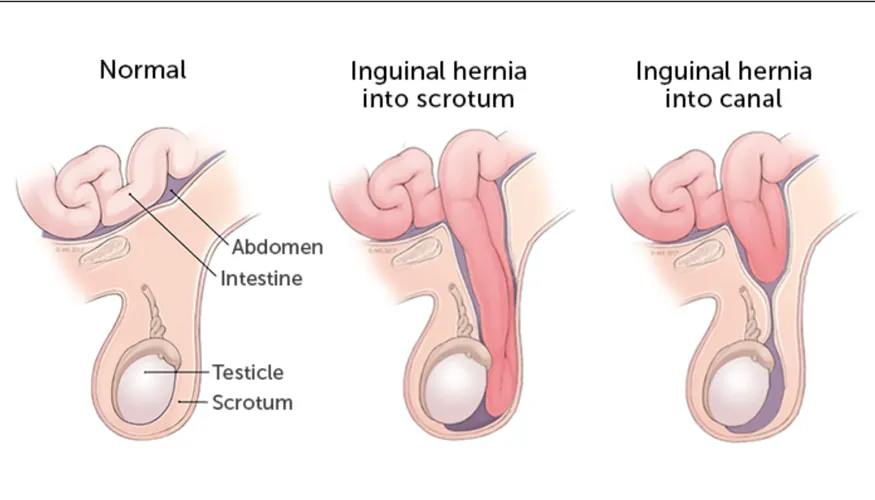
Girls can have an inguinal hernia too. In girls, a band called the round ligament runs through the same canal, and a pouch can stay open beside it. An inguinal hernia is roughly 6 to 10 times more common in boys than in girls. In girls, the ovary can sometimes slip into the pouch, so a lump in a girl’s groin should be examined promptly.
The same open pouch can also cause a hydrocele. If only fluid collects in the pouch, it is a hydrocele. If bowel or other tissue slips in, it is a hernia.
Is a child’s hernia the same as an adult’s?
Parents often compare the two. They are different. In most adults, a hernia comes from weakness. An earlier operation, obesity, smoking and ageing all break down the tissue, and a gap opens where there was none. In a child, the muscle is strong. The pouch was there from birth. That is why the treatment is different too.
| Child’s hernia | Adult hernia |
|---|
| Present from birth, from a pouch that stayed open | Develops later, from weak muscle |
| Strong muscles can squeeze the bowel and trap it | Weak muscles, so trapping is less common |
| Surgery is needed soon after diagnosis | Surgery can often be planned after a period of watching |
| No mesh | Mesh is commonly used |
Mesh is not used in children because it does not grow, and a child is still growing.
Signs parents notice
- A bulge in the groin or scrotum, more visible when the child cries, coughs or strains.
- The bulge often disappears when the child lies down or relaxes.
- In girls, a small lump in the groin or the labia.
A bulge that appears and goes back in is called a reducible hernia. This is the best time to operate. These signs suggest the hernia may be stuck:
- Pain or discomfort, especially when the child is active.
- Swelling or heaviness in the groin that does not settle.
- Irritability and fussiness in a baby.
- Nausea and vomiting.
How the diagnosis is made
A hernia is a clinical diagnosis. The surgeon looks for the bulge and feels the groin, and that is usually enough. The same is true for a hydrocele. An ultrasound is not needed routinely. It is useful in a few situations:
- To look for a hidden defect on the opposite side.
- In an emergency, when the child comes in with blocked bowel, to check that the blood supply to the bowel is healthy.
- When the insurance company asks for proof of the diagnosis.
Does every child need surgery?
Yes. A hernia in a child does not close by itself. Waiting does not make surgery smaller or safer. The reason to operate is simple: bowel can get stuck.
A child’s abdominal muscles are strong. When bowel slips into the pouch and the child cries or strains, those muscles can squeeze it like a tight band. If the bowel holds food or stool, or swells from the squeezing, it cannot go back in. Doctors call this an incarcerated hernia. If the blood supply is cut off, it is called a strangulated hernia, and the bowel can be damaged.
In a Canadian study of 1,065 children under 2 years who were waiting for hernia surgery, about 1 in 8 had the hernia get stuck before the operation [1]. No one can predict when it will happen. This is the reason, and the only reason, a hernia is not left alone. The answer is the same at every age: the risk is real and it cannot be predicted.
When should the operation be done?
Once the diagnosis is made, the operation is best done on the next available theatre list. In the same Canadian study, infants who waited more than 14 days had about double the risk of the hernia getting stuck, and the authors recommended repair within 14 days of diagnosis [1].
Premature babies are planned separately. Repair is scheduled once the baby is stable by NICU criteria, on full feeds and needing minimal oxygen. The European paediatric surgeons’ guideline links repair after discharge from the NICU with fewer breathing problems in premature babies [5].
The operation: open or keyhole
The operation is called a herniotomy. The surgeon removes the pouch and closes the opening at its base, called the deep ring. That is all that is needed. It usually takes 30 minutes to an hour.
- Open surgery: a cut of about 2 to 2.5 cm on the affected side, in the groin crease.
- Keyhole (laparoscopic) surgery: a camera goes in through the navel and two working instruments go in just below it, one on each side. In young children 3 mm instruments are enough.
| Open | Keyhole |
|---|
| Cuts | One groin cut, 2 to 2.5 cm | Three tiny cuts at and below the navel |
| Other side seen | No | Yes |
| Swelling of the cord and scrotum | Can occur | Does not occur |
| Pain | More | Less |
| Hernia coming back on the same side | Lower: about 4 in 1,000 in a large US study [2] | Slightly higher: about 15 in 1,000 in the same study [2] |
| Hernia later on the other side | More likely | Less likely |
This choice is made together with the family. Both methods repair the hernia well. A review of 18 randomised trials with 5,750 children found no significant difference in overall complications, wound infection or testicular atrophy between the two, and it found a lower chance of a later hernia on the other side after keyhole surgery [3]. Large database studies report that a hernia returns on the same side slightly more often after keyhole repair, balanced by fewer operations later for the other side [2]. An Indian single-surgeon series of 1,595 children showed the same pattern [4]. See also laparoscopic and thoracoscopic surgery.
What about the other side?
In many children the opposite side is also open. In a 10-year Indian series, about 4 in 10 children had an open pouch on the other side. When it was left alone, about 1 in 10 of those children went on to develop a hernia [4]. The authors concluded that closing the other side upfront is not always needed.
- Keyhole surgery: the other side can be seen during the same operation. If an open pouch is found, it can be closed in the same sitting.
- Open surgery: usually only the side with symptoms is operated on. A small defect on the other side, with no hernia that can be seen or felt, is left alone.
- The exception: if an ultrasound has shown a hernia sac on the other side, closing it can be agreed with the family beforehand.
Hospital stay and anaesthesia
Most children go home the same day, as day care. The operation is done under general anaesthesia. A caudal block is commonly added for pain relief after surgery. Some children stay overnight, for example if the insurance company requires a 24-hour stay, or if the family does not feel confident taking the child home the same day. One dressing is placed at the time of surgery and removed after 1 week.
Recovery at home
| When | What to expect |
|---|
| Day 1 to 2 | Most children return to normal play and walking. Mild soreness only |
| Day 5 | Bathing can start |
| Day 7 | The dressing is removed. Most children are ready to return to school within the first week, once they are comfortable and pain relief is good |
| Up to 10 days to 2 weeks | No heavy activity: gymnastics, swimming, athletics, lifting heavy weights, long-distance running, cycling |
| After 2 weeks | All activity |
All stitches dissolve by themselves. Keep the wound clean and dry and give pain medicine as prescribed. Contact your surgeon the same day if:
- The groin or scrotum becomes very swollen, red or hot.
- Your child has fever, repeated vomiting or a hard, painful lump.
- The wound bleeds or leaks pus.
Possible complications
Hernia repair is one of the most routine operations in children, and serious problems are uncommon. They include wound infection, a collection of fluid or blood in the scrotum, a hernia coming back and, rarely, a change in the testis. In the large US study of more than 53,000 repairs, a hernia came back on the same side in about 0.4% of open repairs and about 1.5% of keyhole repairs [2]. Problems are more likely when the repair is done as an emergency for a stuck hernia, and in very small babies. This is another reason not to wait.
Why a paediatric surgeon?
Children are not small adults. A baby’s groin anatomy, the way a child is anaesthetised and the fact that the body is still growing all change how a hernia is repaired. Paediatric surgeons and paediatric anaesthetists are trained specifically to operate on and anaesthetise infants and children.
Frequently asked questions
Can girls get an inguinal hernia?
Yes. It is far less common than in boys, roughly 6 to 10 times less, but girls need the same early repair.
What if we do nothing?
The hernia does not close on its own. It can become stuck, which is an emergency and may need urgent surgery.
Will mesh be used?
No. Mesh does not grow with the child.
Is keyhole surgery better?
Each method has advantages. Keyhole lets the surgeon see the other side and gives less pain and no cord swelling. Open surgery has a slightly lower chance of the hernia coming back on the same side. The choice is made together with the family.
When can my child play and go to school?
Usually in 1 to 2 days for play and within the first week for school. Heavy sport and cycling are avoided for 10 days to 2 weeks.
Do stitches need to be removed?
No. All stitches dissolve.
Questions you may want to ask at your visit
- Is my child’s hernia on one side or both?
- Do you advise open or keyhole surgery for my child, and what are the pros and cons of each?
- Will the operation be day care?
- What should I watch for at home?
- When can my child return to school and sport?
Consult your pediatric surgeon early to understand your options. Most children with an inguinal hernia do very well after surgery.
Related pages
References
- Zamakhshary M, To T, Guan J, Langer JC. Risk of incarceration of inguinal hernia among infants and young children awaiting elective surgery. CMAJ 2008;179(10):1001-1005. doi:10.1503/cmaj.070923.
- Carter M, Papastefan ST, Tian Y, et al. A retrospective nationwide comparison of laparoscopic vs open inguinal hernia repair in children. J Pediatr Surg 2025;60(2):162056. doi:10.1016/j.jpedsurg.2024.162056.
- Luo H, Xu J, Chen J, Ni Z. Clinical efficacy of laparoscopic treatment of pediatric inguinal hernia: a meta-analysis. Am J Transl Res 2024;16(10):5155-5167. doi:10.62347/VGGJ1398.
- Shah A, Sharma R, Shah A. Surgical outcomes of laparoscopic versus open inguinal hernia repair in children: a 10-year single-surgeon study. J Indian Assoc Pediatr Surg 2025;30(3):382-386. doi:10.4103/jiaps.jiaps_272_24.
- Morini F, Dreuning KMA, Janssen Lok MJH, et al. Surgical management of pediatric inguinal hernia: a systematic review and guideline from the European Pediatric Surgeons’ Association Evidence and Guideline Committee. Eur J Pediatr Surg 2022;32(3):219-232. doi:10.1055/s-0040-1721420.
Clinic locations
- Manipal Hospital, Sarjapur Road, Bengaluru.
- Manipal Hospital, Electronic City, Bengaluru.
Appointments: +91 8217553785
This page is educational information and is not a substitute for individual medical advice. Drafted with AI assistance and medically reviewed by Dr. Koushik Herle.
