Vesicoureteric Reflux

Understanding Vesicoureteric Reflux (VUR) in Children

What is Vesicoureteric Reflux (VUR)?

Vesicoureteric reflux (VUR) is a condition in which urine flows backward from the bladder into the ureters and sometimes up to the kidneys. Normally, urine travels in one direction—from the kidneys, down the ureters, into the bladder, and out of the body. In VUR, this one-way system is disrupted, leading to a reverse flow, which can cause infections and kidney damage.

The Ureter: A One-Way Road

Think of the ureters as one-way roads designed to transport urine from the kidneys to the bladder. Under normal circumstances, these roads allow urine to flow only in one direction. In VUR, the valves at the junction where the ureters enter the bladder (vesicoureteric junction, VUJ) are defective, allowing urine to travel back up the ureters. This reverse flow can lead to repeated urinary tract infections (UTIs) and potential kidney damage.

Signs and Symptoms of VUR

The symptoms of VUR can vary, but common signs include:

Types of VUR

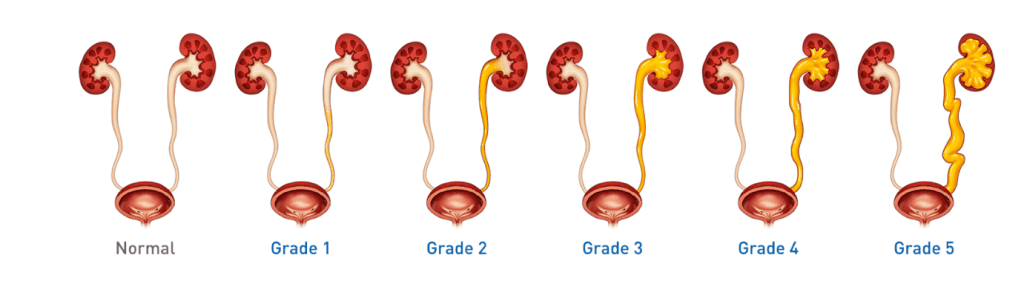
VUR is classified into different grades based on the severity of the reflux. The severity is decided by the extent of swelling of kidney and ureter along with a X ray test called VCUG /MCUG. There are totally 5 grades with 5 being the highest grade .

Vesicoureteric Reflux

Investigations for VUR

To diagnose VUR, several investigations are performed:

Importance of Ultrasound for UTIs in Children below Toilet training age

For infants with a UTI, an ultrasound is essential because it helps detect anatomical abnormalities that could predispose them to recurrent infections and potential kidney damage. Early detection allows for prompt treatment and monitoring to prevent complications. While VUR is just one such cause of UTI, there are multiple anatomical abnormalities which risk the health of the kidneys of infants. Hence any UTI in children who are younger than toilet training age (<3 years) should undergo an USG to rule out hydronephrosis/ hydroureteronephrosis.

Uroprophylaxis Until Age Five

The treatment of VUR varies from patient to patient. These are all the factors that need to be considered before planning a treatment

  • Age of the child
  • Condition of health of the bladder
  • Is there constipation?
  • Is there scarring seen in kidneys as per DMSA scan?
  • Is there worsening of already existing scars?
  • Is there repeated UTIs even when on uroprophylaxis?
  • Is the VUR reducing with age?
  • Female child?
  • Is VUR on only one side or both? (Unilateral / bilateral VUR)
  • Are the kidneys part of Duplex systems?


All children diagnosed with VUR would be started on a low dose antibiotic, to be administered every night. This is called uroprophylaxis. Children would commonly be observed till the age of 5 years. Having said that, it doesn’t mean that the child would not be under surveillance till 5 years. The child would need yearly or half yearly follow ups and the above parameters would be checked. Based on the situation of the child, surgery would be advised. So it may be possible that a few children may not need surgery at all and a few would need surgery – open vs lap vs deflux.

What is a DMSA Scan?

A Dimercaptosuccinic Acid (DMSA) scan is a specialized imaging test used to assess kidney function and detect scarring. During the test, a small amount of radioactive material is injected into a vein. The material travels to the kidneys, allowing detailed images to be captured. This scan is particularly useful in evaluating the extent of kidney damage caused by VUR.

Indications for Surgery

Surgery may be indicated in the following scenarios:

Surgical options include:

Conclusion

Vesicoureteric reflux is a significant condition that requires prompt diagnosis and management to prevent complications. Parents should be vigilant about UTIs in their children, particularly under the age of one, and ensure proper investigations are conducted. With appropriate medical management and, if necessary, surgical intervention, children with VUR can lead healthy, active lives.

Quick Links