Pediatric General Surgery › Meckel’s diverticulum
Meckel’s Diverticulum in Children: Blood in the Stool, Appendicitis-Like Pain and Keyhole Surgery
Medically reviewed by Dr. Koushik Herle, MCh, DNB (Paediatric Surgery), Consultant Pediatric Surgeon and Pediatric Urologist, on 9 November 2026
Your toddler is playing happily, eating well, with no fever and no tummy ache. Then you open the diaper, or look into the toilet, and find a large amount of dark red, maroon or brick-coloured blood mixed in the stool. Or your school-going child wakes up with severe tummy pain and vomiting that looks exactly like appendicitis. Or a baby develops a sudden bowel blockage.
When a child has significant rectal bleeding without tummy pain, or an unexplained abdominal emergency, one of the conditions a pediatric surgeon thinks of is Meckel’s diverticulum. Most parents have never heard of it. It is the most common congenital (present from birth) abnormality of the digestive tract, found in about 2 in 100 people, and most of them never have any problem from it. When it does cause trouble, it can be cured with an operation, often through keyhole incisions.
Key points for parents
- A Meckel’s diverticulum is a small pouch on the wall of the lower small intestine, left over from before birth.
- Most people with one never have symptoms. In children who do, it can cause maroon or brick-red blood in the stool without tummy pain, a bowel blockage, or appendicitis-like pain.
- Routine X-rays and ultrasound often miss it. A Meckel’s scan or a keyhole look (laparoscopy) is used to find it.
- Medicines can calm the bleeding for a time, but surgery to remove the pouch is the cure.
- Most children recover quickly, and eat and play normally afterwards.
Do not wait at home. Go to the nearest emergency department if your child has brick-red, maroon, dark red, “currant jelly” or black tarry stools (even with no pain and a smiling child), sudden paleness, extreme sleepiness, dizziness or a racing heartbeat, green or yellow-green vomit, severe or worsening tummy pain, a child who draws up the legs and cries in waves, or a hard, bloated tummy with fever.
What is a Meckel’s diverticulum?
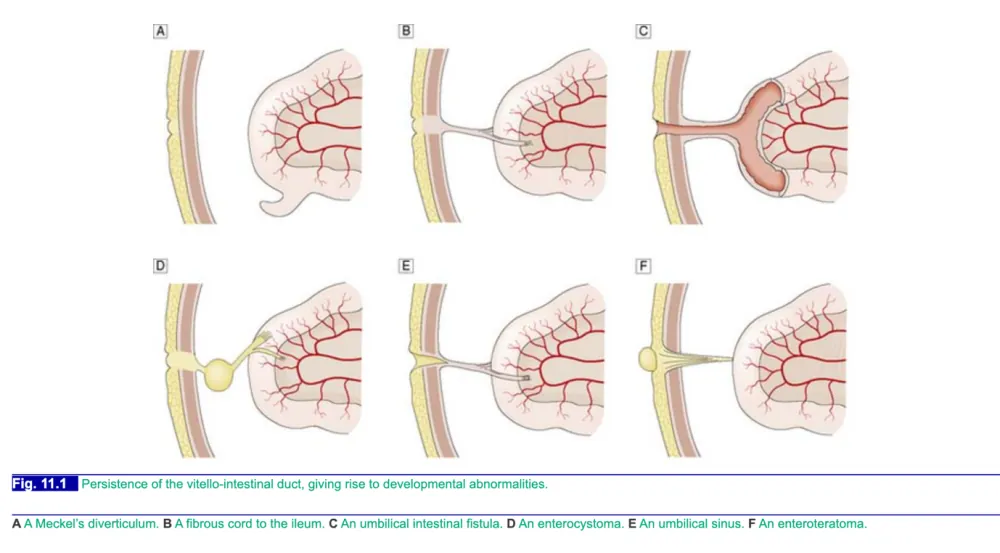
In the first weeks of pregnancy, the baby is fed through a narrow tube (the vitelline duct, or omphalomesenteric duct) that links the middle of the intestine to the yolk sac. Normally this tube dissolves and disappears by about the seventh to ninth week. In about 1 in 50 babies, the part attached to the intestine does not dissolve fully. It leaves a small blind-ended pouch on the side of the lower small intestine (the ileum), a bit like an extra thumb on a glove, a short distance upstream from the appendix.
The “rule of 2s”
Doctors remember it with the “rule of 2s”. These are approximate:
- about 2% of people have one;
- it is typically about 2 inches (5 cm) long;
- it lies about 2 feet (40 to 60 cm) from where the small intestine joins the large intestine;
- most children who have symptoms from it are under about 2 years old, although it can appear at any age;
- symptoms are about 2 to 3 times more common in boys than in girls;
- it can contain 2 kinds of misplaced tissue: stomach lining or pancreas tissue.
Why does a small pouch cause trouble?
Most pouches are lined with normal intestinal cells and cause no problem for a lifetime. The ones that cause bleeding often contain misplaced stomach-lining cells. These cells make acid, as stomach cells do. The stomach has a thick mucus shield against acid, but the small intestine does not. Acid from the pouch burns the nearby intestinal wall, forming an ulcer. When the ulcer erodes a small blood vessel, there is sudden bleeding. The ulcer has few pain nerves, so the child often has little or no pain.
How Meckel’s diverticulum shows up in children
1. Bleeding from the bottom (commonest in children under 5)
- What the stool looks like: brick-red, maroon, dark plum or “currant jelly”. It can be black and tarry if the bleeding is slow, or bright red if it is brisk. A few streaks of bright red blood on the outside of a hard stool is usually a small crack from constipation (an anal fissure).
- It comes and goes. A child may pass one or two maroon stools, then stop for weeks or months, and then bleed more heavily.
- Signs of blood loss (anaemia): pale lips, palms and eyelids, tiredness, dizziness, sleepiness and a fast heartbeat.
2. Bowel blockage
- Intussusception: the pouch can turn inside out and be pulled into the bowel, dragging one segment of bowel into the next like a collapsing telescope. Unlike the common viral type in babies, which can often be pushed back with an ultrasound-guided enema, intussusception caused by a pouch usually needs surgery.
- Twisting or trapping: a fibrous cord can join the tip of the pouch to the belly button or the bowel’s blood supply. A loop of intestine can twist around it (volvulus) or get trapped beneath it (internal hernia), cutting off its blood supply.
- Signs: sudden, severe, crampy pain (a baby draws up the knees and cries every 15 to 20 minutes), green or yellow (bilious) vomiting, a swollen tummy, and not passing stool or gas.
3. Meckel’s diverticulitis (looks like appendicitis)
Like the appendix, the pouch can get blocked by a seed or hard stool and then infected and inflamed. The pain starts around the belly button and moves to the lower tummy, with fever, nausea and vomiting. The pouch sits close to the appendix, so it is very hard to tell from appendicitis before surgery. Like a burst appendix, an inflamed pouch can perforate and cause peritonitis. See also appendicitis in children.
4. Belly button problems in newborns
Rarely, if the whole tube stays open (a patent vitelline duct), a newborn may have a moist red nodule at the belly button that leaks yellow fluid, gas or even stool. Sometimes only a small cyst or a weeping sinus remains. See also the umbilical discharge page.
What else causes blood in a child’s stool?
| Cause | What the blood looks like | Other symptoms | Key feature |
|---|
| Constipation or anal fissure | Bright red, fresh | Straining, crying with a hard stool | Streaks on the outside of the stool or on the wipe |
| Bacterial infection (dysentery) | Mucus with streaks of blood | Fever, cramps | Frequent loose, watery stools |
| Intussusception | “Red currant jelly” | Severe pain in waves, paleness | Baby draws up the knees every 15 to 20 minutes |
| Juvenile colonic polyp | Bright red | Usually none | Spotting at the end of a stool, often at 2 to 6 years |
| Meckel’s diverticulum | Maroon, dark red, brick-red or black | Often no tummy pain | Large amounts; haemoglobin can fall quickly |
How Meckel’s diverticulum is diagnosed
The tests depend on whether the child comes with bleeding or with pain and obstruction.
Why X-rays and ultrasound often miss it
A routine X-ray or ultrasound may look normal. The pouch is a small, soft part of the bowel wall lying among metres of moving intestine, so it is often not seen unless it is swollen, cyst-like or trapped inside an intussusception.
The Meckel’s scan (technetium-99m pertechnetate scintigraphy)
When a stable child has maroon bleeding, the usual test is a nuclear medicine Meckel’s scan. A very small amount of a tracer is injected through a drip. It is taken up by stomach-type lining cells. The child’s normal stomach lights up, and if a pouch contains misplaced stomach lining, a second “hot spot” lights up in the lower tummy at the same time. In some centres, an acid-suppressing medicine is given before the scan to hold the tracer in the pouch and improve the picture. The scan is helpful but not perfect: it can be falsely negative, for example if the lining tissue is very small, the pouch contains pancreas tissue only, or the tracer is washed out by bleeding.
Other tests
- Blood tests: haemoglobin, platelets, clotting, and blood group with cross-match in case a transfusion is needed.
- Ultrasound: useful for intussusception (a “target” or “doughnut” sign) or an inflamed pouch.
- CT, enterography or capsule endoscopy: rarely needed, mainly for older children with slow, unexplained bleeding when the scan is unclear.
- Diagnostic laparoscopy: if bleeding or pain is serious, or the scan is negative but the story is typical, a keyhole camera through the belly button lets the surgeon look at the intestine directly. See also keyhole surgery in children.
Treatment
When a Meckel’s diverticulum has caused bleeding, infection or blockage, surgical removal is the usual cure. Acid-blocking medicines can calm an active ulcer while the child is prepared for surgery, and antibiotics can treat infection, but the pouch with the acid-making tissue is still there, so the problem can return.
Step 1: stabilise the child
A child who has lost a lot of blood is made stable before surgery, with intravenous fluids, acid-suppressing medicine and, if the haemoglobin has fallen a lot, a carefully monitored blood transfusion.
Step 2: the operation
Under general anaesthesia, the operation is often done with keyhole (laparoscopic) or laparoscopic-assisted surgery. A small cut is made in the belly button crease for the camera, with one or two small cuts on the side of the tummy. The surgeon follows the lower small intestine to find the pouch and divides any band attached to it. The pouch is then removed in one of two ways:
- Wedge or stapled removal (diverticulectomy): the pouch is removed across its base, with care not to narrow the intestine. This is suitable when the base is narrow and healthy.
- Removal with a short segment of the neighbouring intestine (segmental resection): the bleeding ulcer usually sits on the intestinal wall next to the base of the pouch, and acid-making tissue may extend into the base. When a child has bled, or the base is thick, firm or wide, surgeons often remove the pouch together with a short length of bowel and rejoin the healthy ends. This helps to remove the ulcer and the acid-making tissue. The choice depends on the findings at surgery, and practice varies between surgeons.
The pouch may be brought out through the belly button opening for removal (laparoscopic-assisted), or removed inside the tummy with a surgical stapler.
What if a Meckel’s diverticulum is found by chance?
Sometimes a child having keyhole surgery for another reason, most often appendicitis, is found to have a Meckel’s diverticulum that was not causing problems. Whether to remove it is a judgement, and the evidence is debated. Pediatric surgeons usually consider:
- the child’s age (a young child has many decades of possible complications ahead);
- whether the pouch feels thick or firm at the base, which can suggest misplaced stomach or pancreas tissue;
- whether the pouch is long and narrow-necked, or has a band attached;
- whether there is pus in the tummy from a burst appendix, which makes extra surgery less safe.
When appendicitis surgery is done and the appendix looks milder than expected, surgeons often check the last part of the small intestine for an inflamed Meckel’s diverticulum.
Hospital stay and recovery
- Hospital stay: commonly a few days after a simple removal, and a few days longer if a segment of bowel was removed and rejoined, or if there was blockage or perforation. Your surgical team will tell you what to expect.
- First days: the child has intravenous fluids and pain relief while the bowel wakes up. Once gas or stool is passed and the tummy is soft, feeding restarts with sips, then liquids and soft foods, and builds up to a normal diet.
- School and play: children are often walking the day after keyhole surgery. Return to school and sports depends on the operation and the surgeon’s advice, usually within a week or two for school and a few weeks for active sports.
- Digestion and vitamin B12: removing the pouch does not usually affect digestion. The last part of the small intestine, which absorbs vitamin B12 and bile salts, is not touched in the usual operation, and the child can eat a normal diet.
- Iron: if the child bled, iron stores may be low. The doctor may advise iron supplements for some weeks and iron-rich foods such as ragi, green leafy vegetables, dates and pulses with a vitamin C source.
Frequently asked questions
Can a Meckel’s diverticulum be cured with medicines alone?
No. Acid-blocking medicines can calm bleeding for a time and antibiotics can treat infection, but the pouch is still there. The acid can burn a new ulcer, or the pouch can twist or become inflamed. Surgical removal is the permanent treatment.
My child’s Meckel’s scan was negative, but the bleeding looked typical. Can it still be a Meckel’s diverticulum?
Yes. A negative scan does not rule it out. If a child has had significant maroon bleeding, especially more than once or needing a transfusion, and other tests are clear, surgeons often recommend a diagnostic laparoscopy to look for the pouch directly.
Will my child need a stoma bag after the operation?
Almost never. In most children the pouch is removed and the bowel is joined back together in the same operation. A temporary stoma is needed only rarely, for example when a child arrives late with a burst bowel and severe infection.
Can it grow back?
Once the pouch is removed, it cannot regrow. If misplaced stomach tissue was left behind, bleeding could rarely return, which is why surgeons take care to remove the pouch and the adjacent ulcer.
Was it caused by something in pregnancy? Will my other children have it?
No. It is not caused by food, medicine or anything the mother did. It is a chance failure of the early tube to dissolve and does not usually run in families, so siblings do not need routine scans unless they have symptoms.
Could it turn into cancer if left alone?
Cancer inside a Meckel’s diverticulum in childhood is extremely rare. Very rarely, tumours have been reported in adults who still have one. This is one reason some surgeons remove a pouch found by chance in a young child.
Questions you may want to ask at your visit
- Is a Meckel’s diverticulum the likely cause, and which test will confirm it?
- Does my child need a blood transfusion or an acid-blocking medicine before surgery?
- Can the operation be done by keyhole?
- Will a segment of the intestine need to be removed?
- What should I watch for after going home?
Consult your pediatric surgeon early to understand your options.
Related pages
References
- Hansen CC, Søreide K. Systematic review of epidemiology, presentation, and management of Meckel’s diverticulum in the 21st century. Medicine (Baltimore) 2018;97:e12154. doi:10.1097/MD.0000000000012154.
- Sagar J, Kumar V, Shah DK. Meckel’s diverticulum: a systematic review. Journal of the Royal Society of Medicine 2006;99:501-505. doi:10.1177/014107680609901011.
- Robinson JR, Correa H, Brinkman AS, Lovvorn HN. Optimizing surgical resection of the bleeding Meckel diverticulum in children. Journal of Pediatric Surgery 2017;52:1610-1615. doi:10.1016/j.jpedsurg.2017.03.047.
Clinic location
- Manipal Hospital, Electronic City, Bengaluru.
Appointments: +91 8217553785
This page is educational information and is not a substitute for individual medical advice. Drafted with AI assistance and medically reviewed by Dr. Koushik Herle.
