Medically reviewed by Dr. Koushik Herle, MCh, DNB (Paediatric Surgery), Consultant Pediatric Surgeon and Pediatric Urologist, on 10 November 2026
Parents are often told that their child will have a “general anaesthetic”, with a “caudal block” or a “spinal” for pain. The words sound alarming, and many parents imagine something being injected into the spinal cord. This page explains the types of anesthesia for children in plain language: what each one does, how it is given, and why it is chosen. For the safety questions (risks, fasting, the developing brain), see the companion page Is anesthesia safe for children?
Key points for parents
- Most children having an operation have general anaesthesia: fully asleep and pain-free. Young children usually fall asleep breathing gas through a mask, and the drip is placed afterwards.
- General anaesthesia is a combination of medicines, not just a gas, which is why a drip is needed even when a mask is used first.
- A caudal block is a common painkiller for operations below the belly button. It is given once the child is asleep and keeps the area comfortable for hours afterwards.
- Spinal and epidural anaesthesia numb the lower body. The needle goes into the fluid or space around the nerves, not into the spinal cord.
- Local anaesthesia numbs a small area and is used for stitches and minor procedures.
- Your child’s anaesthetist chooses the plan according to age, health and the operation.
The types at a glance
| Type | What is numbed | Child awake? | Typical use in children |
|---|---|---|---|
| General | Whole body; fully asleep | No | Most operations: abdomen, chest, longer or delicate surgery |
| Caudal block | Lower tummy, groin, genitals, legs (pain only, mostly) | No (given after general anaesthesia) | Pain relief after hernia, hypospadias, undescended testis surgery |
| Spinal | Lower body, pain and movement | Can be awake or asleep | Selected lower-body operations, older children, some infants |
| Epidural | A band of the body, depending on level | No (usually asleep) | Pain control after major abdominal or chest surgery |
| Local | A small area of skin | Yes | Stitches, small skin procedures, biopsies |
1. General anaesthesia
General anaesthesia is the type used most often in children. The child is completely asleep, feels no pain, does not remember the operation, and the body is relaxed. A specialist anaesthetist watches breathing, heart rate, oxygen, blood pressure and temperature throughout.
How is it started in a child?
Mask (inhalation) induction. For younger children, anaesthesia is often started with a soft mask, similar to the nebuliser masks many children already know. The child breathes oxygen mixed with an anaesthetic gas and drifts off to sleep within a minute or two. Because the gas does the work first, the child does not need a needle while awake. Only once the child is asleep is the drip (an intravenous line, or cannula) placed, so many children never notice it.
Drip first. Older children, or those who are anxious about the mask, may have a numbing cream put on the hand and the drip placed first.
Why is a drip needed if the mask is used?
General anaesthesia is not just a gas. It is a balanced combination of medicines, and most of the others are given through the drip:
- Pain relievers, such as paracetamol.
- Anti-sickness medicines, to reduce nausea after the operation.
- Muscle relaxants, when the operation needs them.
- Fluids, to keep the child hydrated and the blood pressure steady.
- Medicines to protect the stomach.
Doses are calculated from the child’s weight and age and adjusted during the operation.
2. Spinal, epidural and caudal anaesthesia: what is the difference?
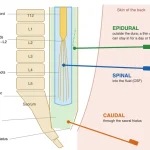
These three are often confused. All three place numbing medicine near the nerves of the lower back, so that the lower body is comfortable. They differ in where the medicine goes. The diagram shows the three routes on a simple side view of the lower spine.
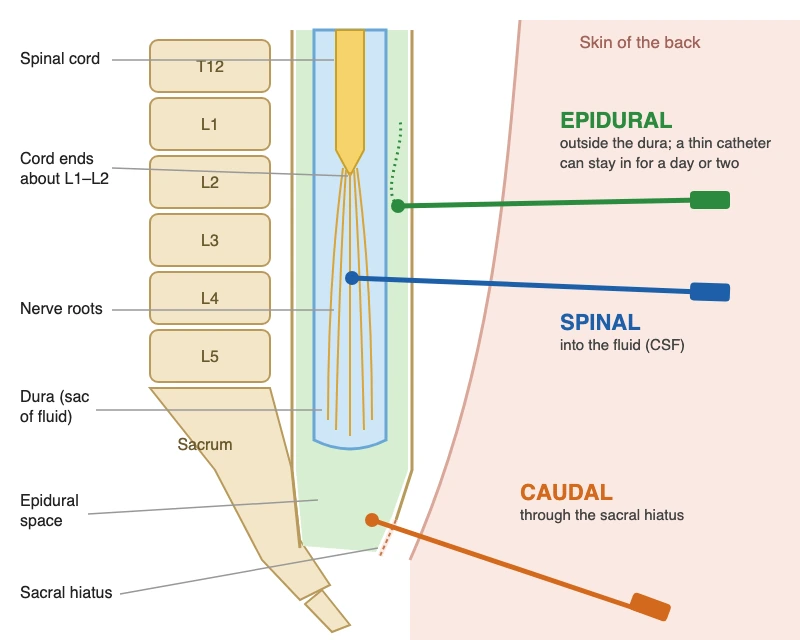
A few terms help. The spinal cord runs down inside the backbone and, in children and adults, ends at about the level of the first or second lumbar vertebra (L1 to L2). Below that, only loose nerve roots continue, floating in a clear fluid called cerebrospinal fluid (CSF) inside a tough sac called the dura. Just outside the dura is the epidural space, a soft, fatty space. In a young baby the cord ends a little lower than in an adult, which the anaesthetist allows for.
Spinal anaesthesia
A spinal places medicine into the CSF, below the level where the spinal cord ends (usually between L3 and L4). It is not an injection into the spinal cord. It works quickly and numbs both pain and movement, so the legs may be heavy or unable to move for a few hours. This is expected and wears off completely.
Spinal anaesthesia is used less often in children than in adults, partly because children are afraid of needles. It can be useful in selected situations, such as certain operations on the lower abdomen or legs, in older children, and for selected infants. Whether it is suitable depends on your child’s age, health and the operation.
Caudal block
A caudal block is one of the most commonly used pain-relief techniques in children. After the child is asleep under general anaesthesia, medicine is injected near the tailbone through a natural opening at the base of the spine called the sacral hiatus. The medicine spreads upwards in the epidural space and numbs the pain signals from the lower tummy, groin, genitals and upper legs.
It is commonly used for operations such as hypospadias repair, hernia repair and undescended testis surgery. It lowers the amount of strong painkiller needed and keeps the child comfortable for several hours after waking. Unlike a spinal, a caudal mainly blunts pain, so leg movement is usually preserved.
Caudal blocks are widely used in children and are considered safe. A large study of more than 18,000 caudal blocks in children found that complications were uncommon and almost always minor, such as a block that did not work fully or a little blood seen at the needle. Serious problems were very rare [1]. Dose accuracy is the main safety point, so the dose is calculated for each child. At Manipal Hospital, caudal blocks are given under ultrasound guidance (point-of-care ultrasound, POCUS), which lets the anaesthetist see the structures and the spread of the medicine.
Epidural anaesthesia
An epidural also places medicine in the epidural space, but at a higher level chosen for the operation. Sometimes a thin flexible tube (an epidural catheter) is left in place so that pain relief can be given continuously for a day or two after a major operation, such as large abdominal or chest surgery. The catheter is removed before the child goes home.
Because the lower nerves are lightly numbed, some children have mild difficulty passing urine for a short time. This is temporary and settles as the effect wears off.
| Spinal | Epidural | Caudal | |
|---|---|---|---|
| Where the medicine goes | Into the CSF, below the end of the cord | Epidural space, at a level matched to the operation | Epidural space, through the sacral hiatus at the base of the spine |
| Effect | Pain and movement blocked | Mainly pain; can be kept running by catheter | Mainly pain; legs usually move |
| Common use in children | Selected lower-body operations | Major abdominal or chest surgery | Pain relief after groin and genital surgery |
3. Local anaesthesia
Local anaesthesia numbs only a small area. Your child stays awake, but the area feels no pain. It is used for stitching small cuts, minor skin procedures and small biopsies, and often as an addition to general anaesthesia so the wound is comfortable afterwards.
Local anaesthetic may work less well in inflamed or infected tissue, such as a painful abscess, because infection makes the tissue more acidic and the medicine spreads and works less effectively. That is why a painful abscess often needs stronger anaesthesia or drainage under sedation or general anaesthesia.
How the plan is chosen
Your child’s anaesthetist decides the plan with the surgical team, based on:
- The operation and how long it will take.
- Your child’s age, weight and general health.
- The expected pain afterwards, and whether a block would help.
- Whether the child has eaten recently, in an emergency.
- Your child’s and your own wishes and worries.
It is common to combine techniques, for example general anaesthesia with a caudal block, so the child is asleep for the operation and comfortable afterwards.
Frequently asked questions
Is a spinal anaesthetic an injection into the spinal cord?
No. The spinal cord ends higher up, around L1 to L2. A spinal places medicine in the fluid around the nerve roots, below that level.
Will my child be awake for a caudal block?
No. A caudal block is normally given after the child is asleep under general anaesthesia.
Why are my child’s legs not moving after a spinal?
A spinal blocks movement as well as pain for a few hours. This is expected and wears off completely.
Can a block cause lasting problems?
Serious or lasting problems are rare. Mild, temporary effects such as numbness or a short delay in passing urine can occur. Your anaesthetist will explain the risks for your child.
Why does my child need a drip if they go to sleep with a mask?
Because anaesthesia is a combination of medicines. The gas puts the child to sleep, and the drip gives pain relief, anti-sickness medicine, muscle relaxants when needed and fluids.
Questions you may want to ask at your visit
- Which type of anaesthesia is planned for my child, and why?
- Will a caudal, spinal or epidural block be used for pain relief, and will it be ultrasound-guided?
- Will my child go to sleep with a mask or a drip?
- Can I stay with my child until they are asleep?
- What should I watch for when my child goes home?
Consult your pediatric surgeon and anaesthetist early to understand your options.
Related pages
- Is anesthesia safe for children?
- Inguinal hernia in children
- Hypospadias
- Undescended testis
- Pediatric general surgery
References
- Suresh S, Long J, Birmingham PK, De Oliveira GS Jr. Are caudal blocks for pain control safe in children? An analysis of 18,650 caudal blocks from the Pediatric Regional Anesthesia Network (PRAN) database. Anesthesia and Analgesia 2015;120:151-156. PubMed 25393589.
- World Federation of Societies of Anaesthesiologists (WFSA). Regional anaesthesia: tutorial resource.
Clinic locations
- Manipal Hospital, Sarjapur Road, Bengaluru.
- Manipal Hospital, Electronic City, Bengaluru.
Appointments: +91 8217553785
This page is educational information and is not a substitute for individual medical advice. Drafted with AI assistance and medically reviewed by Dr. Koushik Herle.