Medically reviewed by Dr. Koushik Herle, MCh, DNB (Paediatric Surgery), Consultant Pediatric Surgeon and Pediatric Urologist, on 20 November 2026
A typical situation: a baby of about nine months has been “colicky” for a day or two. Suddenly he screams, pulls his knees up to his chest and cannot be calmed. A few minutes later he goes quiet and sleepy, almost normal. Then it happens again. Now he has vomited twice and looks pale between the attacks.
This pattern can be intussusception. It is one of the most common tummy emergencies in babies and young children. It is also often missed in the first day or two, because it looks like colic, gas or a stomach bug. The biggest factor in how it turns out is how quickly it is recognised. Found early, it can usually be treated without any operation.
Key points for parents
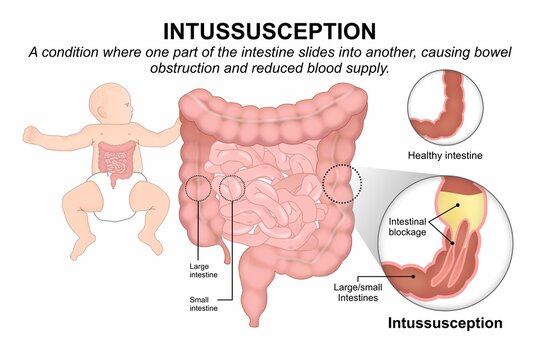
- Intussusception means one part of the bowel slides inside the next part, like a telescope folding in.
- It is most common between 3 months and 3 years of age.
- The key sign is a pattern: bouts of severe crying with knees drawn up, with quiet or sleepy spells in between.
- Ultrasound is the test that confirms it. It is quick and does not hurt.
- Most children caught early are treated with an air or saline enema, with no cut and no operation.
- Surgery is needed if the enema does not work, or if the bowel is damaged.
- Do not wait overnight. Hours matter.
What is intussusception?
Intussusception happens when one part of the bowel slides into the part next to it, the way one section of a telescope or a folded sock slides inside another. Once it is tucked in, the normal squeezing movements of the bowel keep pulling it further in.
The danger is the blood supply. The blood vessels of the bowel get pulled in and squeezed too. Think of standing on a garden hose: at first some water still trickles through, but the longer the pressure stays, the less gets through. The trapped bowel first swells, and the longer it stays folded, the more it is starved of blood.
Once trapped, the bowel swells and becomes harder to unfold. It rarely slides back out by itself, and pressing or massaging the tummy at home does not help.
Why does it happen?
In about 9 out of 10 babies, no specific cause is found. Often there was a cold, fever or diarrhoea in the week or two before. Viruses can swell small patches of immune tissue in the bowel wall. A swollen patch can act like a bump that the bowel catches on and starts to fold over. Millions of children get these viruses and only a very few develop intussusception, so it is not something a parent could have prevented.
In older children, or when it comes back, there is more often a definite cause that the bowel catches on. Doctors call this a lead point. The most common one is a Meckel’s diverticulum, a small pouch of bowel present from birth. Polyps, cysts and swollen lymph glands can also act as lead points. If one is found, it is removed, because leaving it makes another episode more likely.
Types of intussusception
| Type | What happens | Why it matters |
|---|---|---|
| Ileocolic (about 90 in 100) | The end of the small bowel slides into the start of the large bowel. | Usually no cause is found. Responds best to enema treatment. |
| Small bowel into small bowel | One loop of small bowel slides into the next. | Often settles by itself within minutes and may be seen by chance on a scan. If it persists, doctors look for a lead point. |
| Large bowel into large bowel, or mixed | Uncommon in children. | Raises suspicion of a polyp or other lead point, and needs a closer surgical look. |
Signs parents notice
Books describe three classic signs: bouts of pain, vomiting, and “redcurrant jelly” stool (blood mixed with mucus). But by the time children reach hospital, only some have all three. Waiting for all three delays diagnosis.
Look instead for the pattern: sudden waves of severe crying, with spells in between when the child looks almost normal, or unusually quiet and sleepy. The sleepy spells can be more worrying than the crying.
| Age | What parents often notice |
|---|---|
| Babies (3 to 12 months) | Sudden intense crying with knees drawn up, vomiting, refusing feeds, then an unusual quiet or drowsy spell. |
| Toddlers (1 to 3 years) | Repeated tummy pain, refusing to walk or clinging to a parent, vomiting, pointing to the tummy, tiredness. |
| Older children | Cramping tummy pain and nausea in bouts. Because it is less usual at this age, doctors look harder for a lead point. |
Babies draw their knees up because bending the hips eases a sore tummy. It is a useful clue, though it can happen with other tummy problems too.
This is an emergency. Do not wait. Go to the nearest emergency department if your child has: repeated bouts of severe crying that come and go, knees drawn up during the bouts, vomiting that becomes frequent or turns green, unusual sleepiness or floppiness, blood or mucus in the stool, or a swollen, hard or very tender tummy.
Why it is urgent
The longer the bowel stays trapped, the more it swells and the less blood it gets. In time, the bowel wall can die and burst (perforation), spilling bowel contents into the tummy and causing a serious infection called peritonitis. Early on, the same problem can usually be fixed without any cut. The difference is a matter of hours, not days. Do not wait out an episode overnight.
How it is diagnosed
Ultrasound is the test that confirms intussusception. It does not hurt, takes a few minutes, uses no radiation and is very accurate. On the scan, the folded bowel looks like a target or a doughnut. A Doppler scan also shows whether the trapped bowel still has a good blood supply, which helps decide between an enema and surgery.
Blood tests do not diagnose intussusception. They are done to check hydration and infection and to prepare safely for treatment. Sometimes the doctor can feel a sausage-shaped lump in the tummy, but not feeling one does not rule it out. X-rays and CT scans are needed only in unusual cases.
Treatment
Air or saline enema: the first choice for most children
If your child is stable and there are no signs that the bowel has burst, the first treatment is usually an enema. Air or salt water is gently passed into the bowel through the back passage, under ultrasound or X-ray guidance, to push the folded bowel back into place. There is no cut, and most children do not need a general anaesthetic.
It works in about 75 to 95 out of 100 suitable children. Success depends on how long the bowel has been trapped, how swollen it is and where the fold is. When it works, children often brighten within the hour and start feeding the same day.
Surgery: when it is the safer path
Surgery is not a sign of failure. It is the right treatment when:
- the enema does not unfold the bowel despite a fair attempt;
- the bowel has already burst, or there is peritonitis;
- the bowel looks badly damaged;
- a lead point is suspected that needs removing anyway.
Keyhole (laparoscopic) surgery is used where suitable, with smaller cuts, less pain and quicker feeding. When the bowel is very swollen or the tummy is contaminated, open surgery gives better control and is equally safe.
During the operation, the surgeon gently squeezes the bowel back out rather than pulling it, because pulling can tear swollen bowel. Bowel that looks dark at first often recovers its colour once blood flow returns. A piece of bowel is removed and the healthy ends joined only if it is clearly dead, has burst, or contains a lead point. A stoma (bowel opening on the tummy) is rarely needed. See stomas in children.
Recovery
| When | What to expect |
|---|---|
| Same day, after an enema | Most children perk up quickly and feed within hours. Many go home within 24 hours. |
| Days 1 to 3, after simple surgery | Drip fluids at first, then feeds restarted slowly. Some bloating while the bowel “wakes up” is normal. |
| Days 3 to 7, after bowel removal | A longer stay while the bowel join heals and feeding returns to normal. |
| Weeks 1 to 2 at home | Back to a normal diet for age. Daycare or school once your child is comfortable, eating well and back to their usual energy. |
| After 2 weeks | No routine scans are needed after a simple recovery, unless symptoms return. |
Come back the same day after discharge if: the crying-and-quiet pattern returns, your child keeps vomiting or refuses feeds, or has fever, a swollen tummy or unusual sleepiness, or the wound becomes red, swollen or leaks.
Long-term outlook
The outlook is very good. Almost all children go on to eat, grow, play and go to school with normal bowel function. No special diet, medicine or restriction is needed afterwards.
Intussusception comes back in about 5 to 10 out of 100 children, most often in the first days or weeks. It is not caused by anything the parents did. Another enema often works. If it keeps coming back, or happens in an older child, doctors look carefully for a lead point.
Frequently asked questions
Can intussusception happen again?
It can, but most children never have a second episode. It comes back in about 5 to 10 out of 100 children.
Is it hereditary or contagious?
No. It is not usually inherited, and brothers and sisters do not need screening. Intussusception itself is not contagious, though the viral illness before it can be.
Did the rotavirus vaccine cause it?
An older rotavirus vaccine was withdrawn because it raised the risk. Current vaccines are considered safe, with at most a very small, short-lived rise in risk in some settings, far outweighed by their protection against severe diarrhoea. Continue the vaccine schedule your paediatrician advises, and discuss any concerns with them.
Will my child definitely need surgery?
No. Most children diagnosed early are treated with an enema alone. Surgery is for children where the enema fails, or where the bowel has burst, is damaged, or has a lead point.
Can massage or home remedies help?
No. Massage cannot unfold the bowel, and home remedies or pain medicine can hide the signs without treating the blockage. Seek medical care instead.
Questions you may want to ask at your visit
- Did the ultrasound confirm intussusception, and what type is it?
- Is an enema suitable for my child?
- What happens if the enema does not work?
- When can my child eat again, and when can we go home?
- What signs mean we should come back?
Consult your paediatric surgeon early to understand your options. With intussusception, coming in early often means no operation at all.
Related pages
This article is educational information and is not a substitute for individual medical advice. Drafted with AI assistance and medically reviewed by Dr. Koushik Herle.