Medically reviewed by Dr. Koushik Herle, MCh, DNB (Paediatric Surgery), Consultant Pediatric Surgeon and Pediatric Urologist, on 9 November 2026
Childhood injuries happen in an instant. A hot cup of tea pulled off the table. A tumble from the jungle gym. A coin vanishing into a toddler’s mouth. What you do in the first five to ten minutes can reduce pain, prevent complications and, in some situations, save a life. This guide explains what to do, and what never to do, for the most common childhood injuries, and when to go to the nearest emergency department.
In any emergency, go to the nearest emergency department or call for an ambulance. This page is for information and does not replace medical advice.
1. The golden minutes: why the first response matters
Children are not small adults, and that is why pediatric first aid is different from adult first aid:
- Skin: thinner and more sensitive to heat, so burns go deeper and faster.
- Bones: more flexible, and they fracture differently, often as “greenstick” fractures that look mild.
- Airways: narrower, so a small object or swelling can block them quickly.
- Blood volume: smaller, so blood loss that an adult would tolerate can cause shock in a child.
- Fear and pain: children become distressed quickly, which makes assessment and wound care difficult without proper support.
Most parents panic, which is natural. Panic leads to well-meant actions that cause harm: putting toothpaste on a burn, pulling out an embedded splinter, or moving a child with a possible spine injury. Calm, simple steps work better.
Remember: the goal of first aid. First aid does not fix the injury. It stops the injury from getting worse, reduces pain and gets your child safely to the right level of care.
2. Burns: common and often mismanaged
Burns are among the commonest childhood injuries and are often mismanaged at home. Whether the cause is a hot liquid (a scald), a hot utensil, a flame, electricity or a chemical, the first aid principles are the same. See also the pediatric surgeon’s guide to managing minor burn wounds.
Step-by-step first aid for burns
- Remove the heat source. Move your child away from the hot object, liquid, flame or electrical source. If clothing is on fire: stop, drop and roll.
- Cool the burn with running water. Hold the burned area under cool (not cold, not iced) running water for 20 minutes, started within 3 hours of the burn. Set a timer on your phone. This is the most important first-aid step for a burn. It reduces burn depth, eases pain and lowers the need for skin grafting.
- Remove clothing and jewellery. Gently remove clothing from the burned area unless it is stuck to the skin. Take off rings, bangles, bracelets, anklets or necklaces near the burn before swelling makes it impossible.
- Cover loosely. After cooling, cover the burn with a clean, non-fluffy material. Cling film (kitchen wrap) laid loosely works well because it keeps the area clean and does not stick.
- Seek medical care. Even apparently minor burns in children deserve a professional assessment.
What not to do: mistakes that make burns worse
- Do not apply toothpaste, butter, oil, ghee, turmeric, honey, aloe vera from the plant, batter, ink, mud or any home remedy. They trap heat, cause infection and make the assessment harder.
- Do not use ice or ice-cold water. It can cause ice burns and shock in young children.
- Do not burst blisters. They are the body’s own sterile covering.
- Do not put cotton wool directly on a burn. The fibres stick and hurt when removed.
- Do not apply antiseptic creams, lotions or calamine unless a doctor advises it.
- Do not wrap the burn tightly. Leave room for swelling.
Modern burn dressings
Once your child has been assessed, the medical team chooses a dressing. Modern burn care has moved beyond plain gauze:
- Collagen-based dressings: used for some partial-thickness (second-degree) burns. Collagen supports new tissue growth, absorbs fluid from the wound and often needs fewer, less painful dressing changes.
- Silver-containing dressings: used for burns that are infected or at high risk of infection.
- Silicone dressings: non-stick dressings for the face and skin folds, which cause little trauma on removal.
- Biological or skin-substitute dressings: temporary cover for deeper burns while surgery is planned.
The choice depends on the depth and site of the burn, the child’s age and whether there is infection. This is why burns in children need professional assessment and not only home care.
Go to hospital immediately for a burn if:
- Size: the burn is larger than your child’s palm.
- Place: it is on the face, neck, hands, feet, genitals or over a joint.
- Age: any burn in a child under 2 years.
- Depth: deep burns (white, brown or black, or numb, which means nerve damage).
- Cause: electricity, chemicals or steam.
- All the way round a limb, which can cut off circulation.
- If unsure: go. Caution is the right instinct with burns.
When burns need surgery
Deep burns (deep second-degree and third-degree) need surgical treatment, such as removing dead tissue and skin grafting, followed by long-term scar care. Early treatment in the first days after a deep burn helps prevent contractures, the tightening of scar tissue that can restrict joint movement and need further operations if left late.
3. Cuts, lacerations and bleeding wounds
Children fall. Scraped knees and minor cuts are part of childhood and most can be managed at home. Some cannot, and knowing the difference prevents harm.
First aid for cuts and bleeding
- Control the bleeding first. Press firmly and steadily with a clean cloth or pad for at least 10 minutes without lifting it to check. Lifting disturbs the clot. Do not use a tourniquet unless bleeding from a limb is life-threatening.
- Clean the wound. Once the bleeding has stopped, rinse gently with clean running water and remove loose surface dirt. Do not probe the wound or remove deeply embedded objects.
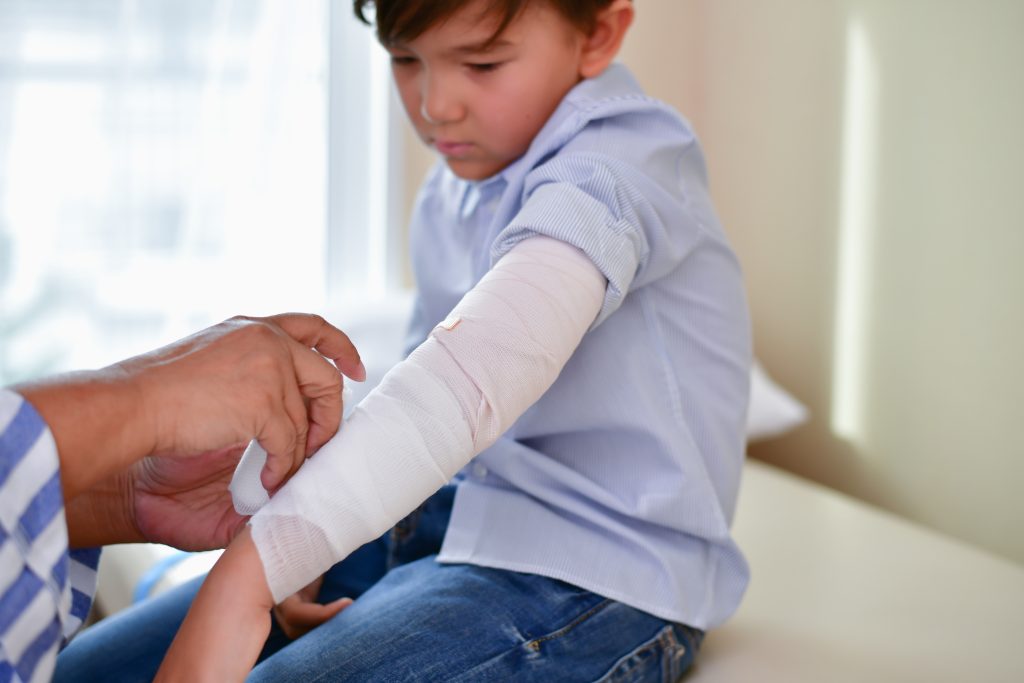
- Cover it with a clean dressing, and keep it dry.
- Check tetanus protection. If your child has not had a tetanus-containing vaccine in the last 5 years, or the wound was caused by a dirty or rusty object, a booster may be needed. Ask your doctor.
Go to hospital if:
- Bleeding does not stop after 10 minutes of firm, continuous pressure.
- The wound edges gape and cannot be held together (it probably needs stitches).
- The wound is on the face, near an eye or over a joint.
- The wound is deep and you cannot see the bottom.
- It was caused by a dirty, rusty or contaminated object, or by an animal bite.
- There is gravel, glass or metal in it that you cannot remove safely.
- Tetanus protection is not up to date.
4. Wound closure: what parents should know about stitches
“Does my child need stitches?” is one of the commonest questions in the emergency department. Knowing the answer before you arrive reduces anxiety.
Does my child need stitches?
Not every cut needs formal closure. The decision depends on:
- Length: short cuts (shorter than about 1 to 2 cm) whose edges come together naturally may be managed with adhesive closure strips.
- Depth: deep wounds that reach fat, muscle or deeper structures usually need stitches to close the layers properly.
- Gaping: if the edges separate when the child moves (for example over a joint or on the face), the wound will not heal well without stitches.
- Location: facial wounds deserve careful closure to keep scarring to a minimum. Scalp wounds bleed a lot but often heal well with stitches or staples.
- Tension: wounds over a joint or the knee need stitches so that they do not reopen.
A note on tissue glue (cyanoacrylate)
Tissue glue is often offered as a quick alternative to stitches. It works for small, clean, shallow cuts whose edges lie together and are not under tension. It is not suitable for deep or gaping wounds, wounds over joints or around the mouth, or wounds that a young child is likely to pick or rub open. Glue seals the surface only and does not support deeper layers. Whether glue, strips or stitches suit a facial cut is for the treating doctor to decide after looking at the wound.
Absorbable and non-absorbable stitches
Parents are often told their child has “dissolving” or “non-dissolving” stitches without being told why it matters.
| Type | Examples | Used for | Removal |
|---|---|---|---|
| Non-absorbable | Nylon, polypropylene (monofilament) | Skin closure, including the face and mobile areas. Many pediatric surgeons use fine monofilament stitches on the face and remove them early. | Yes. Usually about 5 to 7 days on the face, 10 to 14 days on the scalp and body. |
| Absorbable | Polyglactin (Vicryl), poliglecaprone (Monocryl), PDS | Deep layers under the skin, inside the mouth, and skin closure where avoiding a removal visit matters. | No. They dissolve over weeks. |
| Subcuticular (hidden) stitch | Absorbable or non-absorbable thread | Wounds on the body and limbs where a fine line without stitch marks is wanted. The thread runs under the skin. | Non-absorbable: removed at 10 to 14 days. Absorbable: dissolves. |
Both approaches are used, and surgeons differ in their preference. The outcome depends on the wound, the technique, the tension on the wound and the aftercare, and no method can promise that there will be no scar. Fine non-absorbable stitches removed early avoid the track marks that stitches left in for too long can cause, while absorbable stitches avoid a removal visit, which some children find frightening. Ask your surgeon which approach is planned and why.
Sedation for wound closure in young children
A frightened, struggling 2-year-old cannot keep still for stitches with local anaesthesia alone. Trying to stitch a child who is moving upsets the child and makes a precise repair difficult. For this reason, young children may be given procedural sedation, a short-acting sedative given in a monitored setting.
- Sedation is not general anaesthesia. It is a brief, monitored sedative, usually given as a day-care procedure with recovery in about an hour or so, and the child goes home the same day. Where it is available and how it is arranged varies between hospitals.
- Younger children (roughly under 5) often need sedation for anything but the smallest cuts.
- Older children can usually cooperate with a calm explanation and local anaesthesia. The local anaesthetic is injected with a fine needle and slow technique to reduce discomfort.
- If the right team is not available at night, the wound is often cleaned, covered and closed the next morning, provided it is clean and the delay is safe. A clean wound on the face can usually be closed after several hours, and often within about 24 hours, with good results. Your doctor will advise.
Wound care at home after stitches
- Keep the wound dry for the period your doctor advises, often 5 to 6 days. Water softens the edges and raises the risk of infection.
- Leave the dressing in place unless your doctor says otherwise. If it comes off and the wound is clean and dry, it does not always need replacing.
- Watch for infection: spreading redness, warmth, swelling, discharge or fever. Go back to the doctor the same day.
- Come for removal on the day advised. Stitches left in too long can leave track marks.
- Protect the scar from sun for 6 to 12 months with a sunscreen or cover, to avoid darker pigmentation.
5. Head injuries: take them seriously
Children bang their heads all the time. Almost all knocks are harmless, but a few are not, and knowing the warning signs is the key.
Reassuring signs (usually safe to watch at home)
- Cried straight away.
- Distress that settles within 10 to 15 minutes.
- No loss of consciousness.
- Acting normally: eating, playing, responding as usual.
- No vomiting, or a single vomit in the first hour.
Warning signs: go to the nearest emergency department now
- Loss of consciousness, even briefly.
- Vomiting more than twice after the injury.
- A seizure.
- Unusual drowsiness or confusion, or difficulty waking the child.
- A large gaping scalp wound that is bleeding heavily.
- Clear fluid from the nose or ears.
- Pupils of unequal size.
- A headache that gets worse over time.
- A high-energy accident, such as a road crash, a fall from a height greater than the child’s own height, or a collision in sport. Go regardless of how the child looks.
A child can look well after a significant head injury and get worse over the next hours. If in doubt, go to the emergency department. A CT scan can be done quickly and will either reassure you or find an injury that needs treatment.
6. Fractures and suspected broken bones
Children’s bones are more flexible than adults’ bones. The classic childhood fracture is the greenstick fracture, in which the bone bends and cracks on one side without breaking completely. It can look mild from the outside but still needs treatment.
Signs of a possible fracture
- A snap heard or felt at the time of injury.
- Severe pain that gets worse with movement.
- Swelling, bruising or a visible deformity.
- The child will not use the limb or put weight on it.
- Tenderness when you press directly over the bone.
First aid for fractures
- Immobilise, do not straighten. Support the limb in the position you find it. A rolled magazine, folded newspaper or a firm board, secured with cloth, makes a temporary splint.
- Apply ice wrapped in a cloth, 10 minutes on and 10 minutes off. Never put ice directly on the skin.
- Get medical evaluation. Suspected fractures need an X-ray. Do not wait to see if the swelling settles.
Open fracture (bone visible through the skin) is an emergency. Cover the wound loosely with a clean cloth. Do not push the bone back or try to clean it. Go to the nearest emergency department at once.
7. Swallowed and inhaled objects: a hidden emergency
Children from about 6 months to 4 years explore with their mouths. Swallowed and inhaled objects are among the commonest pediatric emergencies. See also the pages on swallowed objects and the foreign body in the airway.
Swallowed objects: the basics
Most small, smooth, non-sharp objects that reach the stomach pass by themselves within a few days. The danger zone is the oesophagus (food pipe). An object stuck there causes drooling, refusing food, vomiting or chest discomfort.
- Never try to make the child vomit. It can cause further injury, especially with sharp objects or batteries.
- Do not give extra food or water to “push it down”.
- If the child is comfortable and the object is confirmed in the stomach, the doctor may advise watching for it to pass, which usually takes a few days.
- If the child has drooling, refuses food, vomits or has chest pain, go to the emergency department at once.
The button battery emergency: do not wait
Button (disc) batteries are the flat, round batteries found in watches, remote controls, hearing aids, key fobs, LED tea-lights, musical greeting cards and toys. A swallowed button battery is among the most dangerous swallowed objects in pediatric medicine.
- Why: a battery stuck in the oesophagus makes an electrical current that causes a chemical burn. Tissue damage can begin within about 2 hours.
- The damage is hidden: the child may look completely well while the battery burns through the wall of the food pipe.
- Time matters: the battery needs to be removed by endoscopy as soon as possible, ideally within about 2 hours of known or suspected swallowing. Do not wait for symptoms. By then the damage may be severe, including injury to the windpipe or a major blood vessel, which can be fatal.
- In the nose: a battery in the nose is also dangerous and can erode the nasal septum within hours.
If you suspect your child has swallowed or inhaled a button battery, go straight to the nearest emergency department that can manage it. Take the packaging or the device with you if you can.
Magnets: another object that cannot wait
If two or more magnets, or a magnet and a metal object, are swallowed, they can attract each other across loops of bowel and cause pressure damage, holes and abnormal connections. Swallowing more than one magnet is always a surgical emergency.
Choking: an inhaled object
If your child is coughing hard, encourage the cough. A strong cough is the body’s best way to clear the airway. Do not interfere.
If the child cannot cough, cannot breathe, cannot cry, or the lips and fingertips are turning blue:
- Under 1 year: 5 back blows between the shoulder blades, then 5 chest thrusts. Never use abdominal thrusts in infants.
- Over 1 year: 5 back blows, then 5 abdominal thrusts.
- Call for emergency help straight away while you do this.
- Even if the object is coughed out, have your child checked. A chest X-ray shows whether anything remains. Nuts and organic material that stay in the airway can cause severe lung inflammation.
Pediatric surgeons remove inhaled foreign bodies with rigid or flexible bronchoscopy, using instruments sized for the child.
8. Toy safety and preventing foreign body injuries
Many foreign body injuries can be prevented by choosing age-appropriate, certified toys and childproofing the home.
Safety marks on toys
- CE marking (European standard). A CE mark means the toy claims to meet the European toy safety standards (EN 71), which cover mechanical safety (no sharp edges or small parts for the stated age), flammability, chemicals such as lead and phthalates, and electrical safety. A CE mark alone does not prove a toy is genuine, because fake marks exist. Buy from reputable retailers.
- BIS (Indian standard). In India, toys are covered by IS 9873 (Parts 1 to 9), and under the Toys (Quality Control) Order 2020, BIS certification is mandatory for toys made, imported or sold in India. Look for the ISI mark. You can check a toy or manufacturer on the BIS Care app or at bis.gov.in.
What to look for on the packaging
- An age warning such as “Not suitable for children under 36 months: small parts”. This is a choking warning.
- The manufacturer’s name and address, which counterfeit toys often lack.
- A batch or lot number.
- Material safety information.
- A battery compartment secured with a screw that needs a tool to open, never one a child can open with fingers.
Childproofing at home
- Button batteries: check every device (remote controls, wall clocks, scales, greeting cards, LED tea-lights, torches). Tape any compartment that opens without a tool. Throw away old batteries in a sealed container at once.
- Coins: keep loose change out of reach of children under 4. A 5-rupee coin is close to the width of a child’s food pipe at its narrowest.
- Small items: if an object fits inside an empty toilet roll tube, it is a choking risk for under-3s.
- Balloons: uninflated or burst balloon pieces are among the most dangerous choking hazards. Keep latex balloons away from children under 8 or supervise closely.
- Food: cut grapes, cherry tomatoes and other round foods in half. Avoid whole nuts under 5.
- Magnets: remove high-powered magnet sets from homes with young children.
- Craft supplies: store beads, button eyes and small bricks in sealed containers.
9. When does a child need a pediatric surgeon?
Some injuries and conditions need a pediatric surgeon and not only a general emergency assessment:
- Abdominal injury after a fall or accident. Internal organ damage may not show on the outside. See abdominal injuries in children.
- Open fractures.
- Large or deep burns that need removal of dead tissue or skin grafting.
- Swallowed or inhaled objects that need endoscopic removal.
- A button battery or more than one magnet swallowed.
- Scrotal pain or swelling in a boy, which may be testicular torsion, an emergency within hours.
- Severe tummy pain, which could be appendicitis, intussusception or another surgical cause.
- Neck swellings or injuries after trauma.
- A facial or deep wound in a young child that needs closure with sedation (see section 4 and head, neck and skin surgery).
10. First aid at a glance
| Situation | First action | Safe to watch? | Go to hospital if |
|---|---|---|---|
| Minor burn (small, superficial) | Cool running water for 20 minutes | Yes, if small and superficial | Palm-sized or bigger; face, hands, genitals; child under 2 |
| Deep or large burn | Cool water, call an ambulance | No: always hospital | Always |
| Cut or bleeding wound | Firm pressure for 10 minutes with a clean cloth | If bleeding stops and the edges meet | Bleeding continues; gaping; deep; dirty; tetanus risk |
| Head injury | Keep still, watch closely for several hours | Yes, if only reassuring signs | Loss of consciousness, repeated vomiting, seizure, drowsiness, unequal pupils |
| Suspected fracture | Immobilise, ice wrapped in cloth | No: needs an X-ray | Deformity, bone visible, cannot bear weight |
| Swallowed coin | Stay calm, do not induce vomiting | If no symptoms, see a doctor today | Drooling, refusing food, vomiting, chest pain |
| Button battery or magnets | Go immediately | Never: always an emergency | Any suspected swallowing |
| Choking | Back blows and chest or abdominal thrusts | No: always have the child checked | Blue lips, cannot cry, cough or breathe |
| Wound that may need stitches | Pressure, clean cloth, see a doctor | Not if the wound is gaping | Gaping, on the face, deep or dirty |
Frequently asked questions
My toddler pulled a cup of tea onto her hand. It looks red and she is crying. What do I do first?
Hold the hand under cool (not cold) running water straight away and keep it there for 20 minutes. Set a timer. Remove any bangles or rings before the hand swells. Do not use toothpaste, oil, butter or any home remedy. Cover it loosely with cling film. Any burn on a child’s hand should be seen by a doctor, because the hand has tendons, joints and fine nerves and blood vessels that even a superficial burn can affect.
My son fell at school and has a gaping cut on his forehead. He is 3 years old. Will he need general anaesthesia for stitches?
A gaping facial cut in a 3-year-old needs proper stitches, and at this age the repair is often done with procedural sedation. This is not general anaesthesia. It is a short-acting sedative in a monitored setting, usually as a day-care procedure. The wound is cleaned carefully and closed, often with fine stitches that are removed after about 5 to 7 days. Keep the wound dry as advised. If the team that does this is not available at night, the wound is commonly cleaned and covered, and closed the next morning if it is clean.
My 7-year-old has a cut on his chin. Does he need sedation?
At 7, most children can cooperate with stitches under local anaesthesia after a calm explanation. The local anaesthetic is injected gently with a fine needle and a slow technique. Many surgeons use a dissolving stitch under the skin on the chin so that no return visit for removal is needed, but the choice depends on the wound.
My daughter may have swallowed a button battery but seems fine. Should I wait?
No. If there is any chance your child swallowed a button battery, go straight to the nearest emergency department. The battery can start burning the food pipe within about 2 hours, and serious injury can follow within hours, even when the child has no symptoms. An X-ray confirms it and the battery usually needs urgent endoscopic removal.
I think a battery went up my 2-year-old’s nose. Should I try to remove it?
No. Probing the nose can push the battery deeper or cause more injury. A button battery in the nose causes the same chemical burn as one in the food pipe. Go to the emergency department immediately.
Are all toys on Indian online marketplaces safe?
Not necessarily. BIS certification is mandatory for toys sold in India, but enforcement on online marketplaces is still developing and fake CE marks are common. Buy from established retailers, look for the ISI mark, check the manufacturer on bis.gov.in or the BIS Care app, and follow the age recommendation. Do not buy toys whose battery compartment opens without a tool for children under 6.
My 4-year-old swallowed a 5-rupee coin yesterday and has no symptoms. Does he need an X-ray?
Yes, an X-ray today is the right step. Coins that reach the stomach almost always pass within a few days. A coin in the oesophagus is different, and you cannot tell the two apart without an X-ray in a child with no symptoms. If the coin is in the stomach and there are no symptoms, the doctor may advise watching. If it is in the oesophagus, it will need removal.
The wound from school is still gaping the next day. Is it too late for stitches?
Often not. Clean wounds can commonly be closed within about 12 to 24 hours with good results, and sometimes later if the wound has been kept clean and shows no sign of infection. Beyond that, doctors may consider delayed closure. The deciding question is whether the wound is clean and free of signs of infection (spreading redness, warmth, pus, smell). If it is, get it assessed.
My son has had pneumonia three times in the same part of the lung. Should I be worried?
Pneumonia that keeps returning in the same part of the lung can point to a structural problem, such as a congenital lung malformation, or a lodged inhaled object. A CT chest usually finds the cause. Repeated infection in an abnormal area can damage the lung, so ask for a pediatric surgical opinion.
Questions you may want to ask at your visit
- Does my child’s wound need stitches, glue or strips, and why?
- Will my child need sedation, and who will give it?
- When will the stitches be removed, and how do I care for the wound?
- Does my child need a tetanus booster?
- Which signs mean I should come back the same day?
Consult your pediatric surgeon early to understand your options.
Related pages
- Managing minor burn wounds
- What to do when your child sustains an injury
- Abdominal injuries in children
- Swallowed objects in children
- Foreign body in the airway
- Head, neck and skin surgery
References
- NHS. Burns and scalds.
- NHS. Cuts and grazes.
- NHS. Head injury and concussion.
- National Institute for Health and Care Excellence. Head injury: assessment and early management (NG232).
Clinic location
- Manipal Hospital, Electronic City, Bengaluru.
Appointments: +91 8217553785
This page is educational information and is not a substitute for individual medical advice. Drafted with AI assistance and medically reviewed by Dr. Koushik Herle.