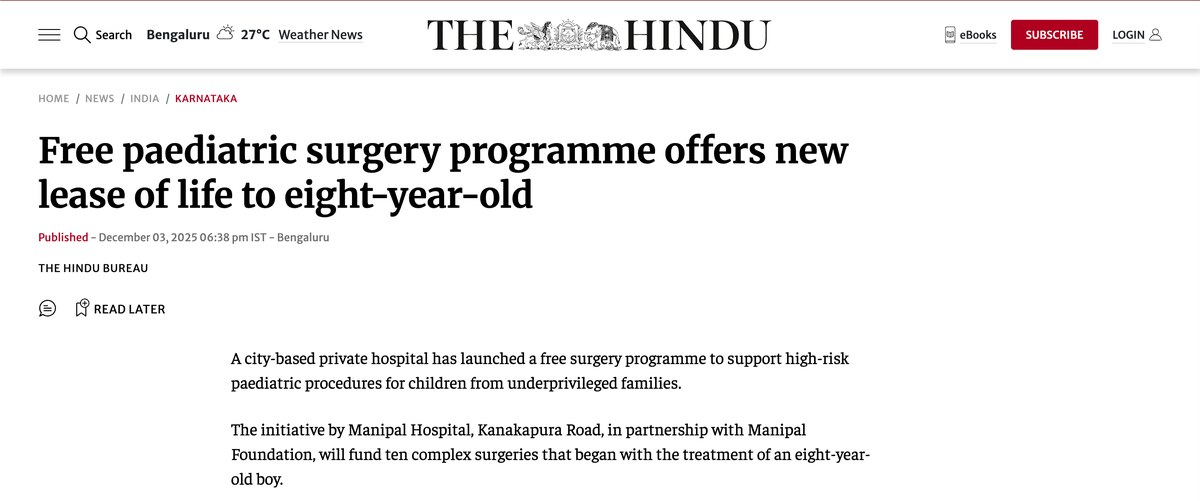
In the media · December 2025
Free paediatric surgery programme offers new lease of life to eight-year-old
The coverage describes a programme in which Manipal Hospital, Kanakapura Road, with Manipal Foundation, funds ten complex paediatric surgeries for children from low-income families. The first child supported was an eight-year-old boy with a rare congenital defect of the windpipe and food pipe, operated on in November 2025 by a multidisciplinary team led by Dr Koushik Herle and Dr Dheeraj Balaji. The Udayavani clipping (Bengaluru edition, Kannada) is shown above.
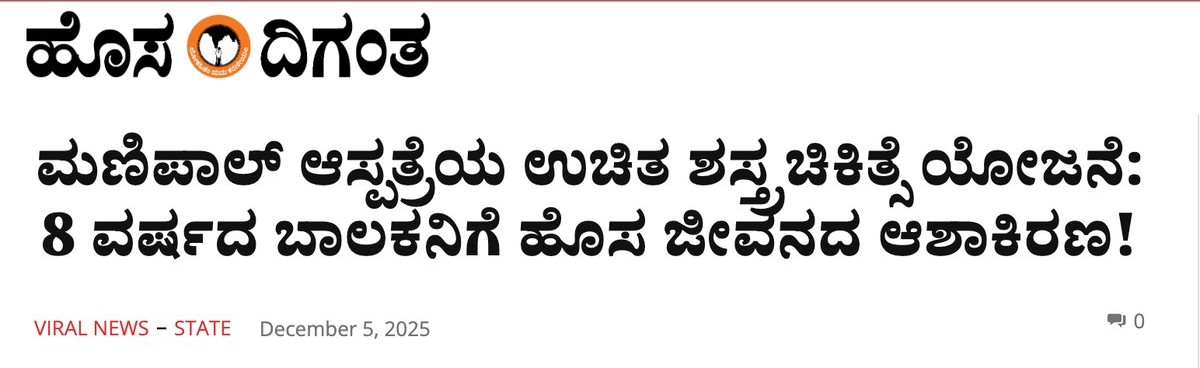
ಹೊಸ ದಿಗಂತ · 5 ಡಿಸೆಂಬರ್ 2025
ಕನಕಪುರ ರಸ್ತೆಯ ಮಣಿಪಾಲ್ ಆಸ್ಪತ್ರೆ, ಮಣಿಪಾಲ್ ಫೌಂಡೇಶನ್ ಸಹಯೋಗದೊಂದಿಗೆ ಆರ್ಥಿಕವಾಗಿ ಹಿಂದುಳಿದ ಕುಟುಂಬಗಳ ಮಕ್ಕಳಿಗಾಗಿ ಹತ್ತು ಸಂಕೀರ್ಣ ಶಸ್ತ್ರಚಿಕಿತ್ಸೆಗಳ ಸಂಪೂರ್ಣ ವೆಚ್ಚವನ್ನು ಭರಿಸುವ ಯೋಜನೆಯನ್ನು ಆರಂಭಿಸಿದೆ. ಈ ಯೋಜನೆಯ ಮೊದಲ ಫಲಾನುಭವಿ 8 ವರ್ಷದ ಬಾಲಕ. ಡಾ. ಕೌಶಿಕ್ ಹರ್ಲೆ ಮತ್ತು ಡಾ. ಧೀರಜ್ ಬಾಲಾಜಿ ನೇತೃತ್ವದ ಬಹುವಿಭಾಗೀಯ ತಂಡವು ನವೆಂಬರ್ 2025ರಲ್ಲಿ ಶಸ್ತ್ರಚಿಕಿತ್ಸೆ ನಡೆಸಿತು.
ಹೊಸ ದಿಗಂತದಲ್ಲಿ ಓದಿ →
Treating rare congenital conditions requires more than just medical expertise; it requires resilience, precision, and a compassionate, multidisciplinary approach. This educational case describes an 8-year-old boy born with a rare and complex congenital abnormality who underwent redo surgery for a recurrent fistula. It highlights the importance of early diagnosis and multidisciplinary teamwork.
A Difficult Start: The Silent Struggle
The boy was born with Esophageal Atresia with distal Tracheoesophageal Fistula (EA+TEF)—a condition where the food pipe ends blindly and connects abnormally to the windpipe. Although he underwent life-saving surgery as a newborn, the condition carries a risk of long-term complications.
For eight years, his life was defined by struggle. He suffered from repeated chest infections, chronic cough, vomiting after feeds, and stunted growth. His sleep was constantly disrupted by nighttime coughing. Tragically, during these challenging years, the child also lost both his parents to the COVID-19 pandemic, leaving him in worsening family circumstances.
A recurrence of the fistula was confirmed in 2023, but previous attempts at closure were unsuccessful, leading to a period of misdiagnosis while the underlying issue persisted silently.
Understanding the Condition: What is Tracheoesophageal Fistula (TEF)?
To understand the gravity of this case, one must understand the anatomy. Normally, the esophagus (the food pipe) and the trachea (the windpipe) are two separate tubes. In a child born with TEF, there is an abnormal connection—a fistula—between them.
Because of this abnormal connection, fluids or food can pass from the food pipe into the lungs. This leads to:
- Choking and Aspiration: Food enters the lungs instead of the stomach.
- Recurrent Pneumonia: Fluid in the lungs causes chronic infection.
- Severe Malnutrition: The child cannot retain food effectively.
In this boy’s case, the fistula had recurred, causing severe, cumulative damage to his lungs over eight years.
Early Diagnosis and Detailed Evaluation
Early identification was important in this case. While the condition was missed for several years due to differing reports from various centers, the case was correctly identified during community outreach activities in 2025.
The child underwent a series of detailed diagnostic tests under the evaluation of a pediatric surgeon. A CT scan revealed severe bronchiectasis (permanent damage) of the left lung, marked lung volume loss with a mediastinal shift, and compensatory overexpansion of the right lung.
Crucially, the evaluation highlighted severe malnutrition: at 8 years old, the boy weighed only 15 kg.
Pre-Operative Optimization: Preparing for the Major Procedure
Surgery was not immediately possible due to the child’s frail state. As part of an integrated care approach, treatment was planned at a specialized tertiary care center while coordination continued with the referring unit.
Before the surgery could take place, a critical step of pre-operative optimization was implemented. Over two months, the team managed nasogastric feeds and high-calorie supplementation. This coordinated effort helped him gain a crucial 3 kg, ensuring he was safe for anesthesia and the major surgery.
The Surgery: Redo TEF Repair
The surgical procedure was carefully planned and performed by the pediatric surgery team. Given the rarity of the condition—a recurrent TEF—the surgery required careful technique.
On 19th November 2025, the surgical team performed a complex Redo TEF Repair. The procedure involved:
- Right Thoracotomy: Accessing the chest cavity.
- Dissection: Carefully separating scarred tissues.
- Repair: Clipping, dividing, and reinforcing the fistula to prevent future recurrence.
The surgery lasted six and a half hours due to significant scarring and distorted anatomy from previous interventions, yet the team successfully corrected the structure while preserving function.
Postoperative Care and Recovery
Following the surgery, the child was closely monitored in a controlled medical environment. He spent two days in the ICU and was mobilized by Day 5.
A contrast study performed on Day 7 confirmed that the repair was intact. The child responded well to treatment and progressed to a normal diet without aspiration, marking a significant recovery milestone.
Learning Points
A recurrent TEF is uncommon and can be missed when chest symptoms continue after neonatal repair. Persistent cough, repeated chest infections and poor feeding after oesophageal atresia repair deserve specialist evaluation. Outcomes vary from child to child.
Today, the boy can eat, drink, sleep, and breathe normally. He is attending school and playing like any other child. His journey highlights the power of early identification, seamless coordination between medical units, and the impact of philanthropic support in bridging the gap for children from economically challenged backgrounds.